What Integral Human Development Requires of Us Now: Optimizing Integral Human Development -- Understanding the Social Mission of the Catholic Church, Part 10.
Part 10 of a ten-part series on the social mission of the Catholic Church

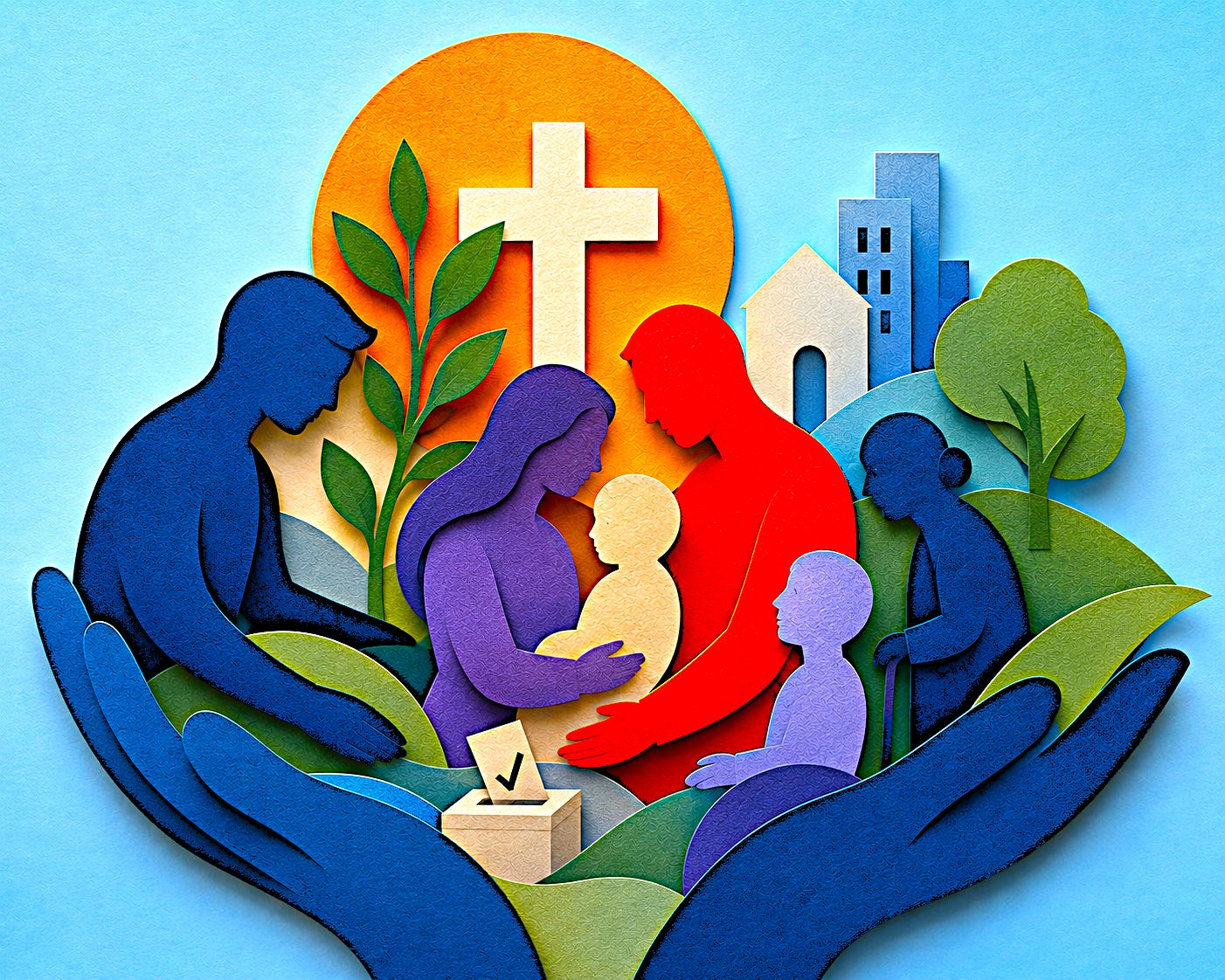
This is Part 10 of Optimizing Integral Human Development, a ten-part series on the social mission of the Catholic Church. This installment turns from the teaching to the obligation it imposes, and asks what integral human development requires of Catholics who choose the officials who govern them.
Part 10: What Integral Human Development Requires of Us Now
Part 9 identified the Catholics and Catholic institutions whose politics contradict the Church’s social teaching. Identifying the opponents leaves the question this series has deferred: what the teaching asks of the Catholic who accepts it. The preceding chapters established that integral human development is the settled social doctrine of the Catholic Church -- traced from Aristotle to Leo XIV, affirmed by six consecutive popes, embedded in the Dicastery for Promoting Integral Human Development, and applied by Magnifica Humanitas to artificial intelligence and the dignity of work. A doctrine that binds the conscience imposes obligations, and the most consequential of them is the obligation to vote.
Leo XIV Hands the Catholic a Measure to Apply
In Magnifica Humanitas, Leo XIV presents Catholic social teaching as a framework for judgment: every economic arrangement, political program, and technology is to be assessed by whether it serves the development of the whole person and of every person. The framework yields no slate of candidates and no party registration. It supplies a measure and requires the Catholic to apply it to the particular thing in front of him.
In a democracy, the particular thing in front of the Catholic is most often a ballot. The officials he elects write the tax code, set the immigration rules, fund or defund the safety net, authorize or restrain war, regulate or ignore the firms that deploy artificial intelligence, and decide who is executed and who is spared. The vote is the layperson’s most direct instrument over the temporal order, and the measure bears on it first.
The Catholic Applies the Measure First to the Candidates on the Ballot
The Second Vatican Council assigned the renewal of the temporal order to the laity, and the Catechism makes participation in public life an obligation that follows from the dignity of the person rather than a preference left to taste. Voting is the ordinary form that obligation takes. The Council and the Catechism settle that the Catholic must participate. What they leave to him is whether his participation advances the good of every person or only the good of some.
Officials who follow Catholic social teaching need not be Catholics. The test is the direction of their programs: whether, taken as a whole, they move society toward the development of every person -- the worker and the migrant, the unborn child and the condemned prisoner, the elderly patient and the displaced refugee. The candidate’s religion stays out of it; his policies decide.
The Measure Runs Through Every Issue the Series Examined
Applied to candidates, the standard grants no single issue a veto over the others.
The just wage and the rights of labor that Leo XIII defended in Rerum Novarum bear on the minimum wage, the right to organize, and the conditions of work. The universal destination of goods, and Francis’s warning in Evangelii Gaudium against “an economy that kills,” measure whether a candidate’s fiscal program protects the poor or sacrifices them.
The migrant, whom Francis placed at the center of the Church’s social mission and defended in his February 2025 letter to the United States bishops, bears on immigration, asylum, and deportation. The racism and nationalism that rank persons by blood or birthplace, which Part 6 set against the standard, reach every policy that sorts human beings by origin. Care for creation, which Laudato Si’ made integral to the Church’s teaching, shapes environmental and climate policy.
The death penalty, which Francis declared inadmissible in his 2018 revision of the Catechism, bears on a candidate’s appetite for executions. The Church’s call to avoid war, taught from Gaudium et Spes through Fratelli Tutti, decides whether a candidate reaches first for force or for peace.
The unborn child, excluded by no clause of the standard, bears on abortion. The elderly, the sick, and the disabled -- those whom Leo XIV called, before Spain’s Parliament, the measure of a just society, and whom Francis described as exposed to a hidden euthanasia -- bear on assisted suicide and the funding of care.
Religious freedom, which Dignitatis Humanae rooted in the dignity of the person, tests a candidate’s respect for conscience against the integralist temptation to coerce it. The dignity of work under artificial intelligence, the subject of Magnifica Humanitas, asks whether a candidate subjects data, algorithms, and the firms that own them to the common good or leaves them to concentrate power unchecked. Every issue on that list binds the Catholic’s judgment, and none of them is the whole of the standard.
No American Coalition Reflects the Full Scope of the Standard
No current American political coalition reflects the full scope and depth of what the Church means by optimizing integral human development. Each carries part of what the standard demands and sets the rest against it. A Catholic who finds his politics already complete inside either coalition has stopped letting the measure work.
The standard was built to cut across the parties of every age. Maritain set it against liberal capitalism and Marxist collectivism at once, and John Paul II condemned unbridled capitalism and atheistic communism in a single breath. The standard cuts across the American coalitions exactly as it cut across the ideologies Maritain and John Paul II faced.
The Church Rejects Single-Issue Voting
Some Catholics escape that discomfort with a shortcut: they choose one issue, usually abortion, and vote on it alone. The magisterium closes that exit. The Church teaches that abortion and euthanasia carry grave and, in the judgment of the United States bishops, preeminent weight; it does not teach that a Catholic discharges his duty by attending to them and ignoring everything else.
Francis stated the principle in Gaudete et Exsultate, in the section on the ideologies that strike at the heart of the Gospel. The defense of the unborn, he wrote, must be unequivocal, firm, and impassioned, and in the same paragraph he called the lives of the poor, the destitute, the trafficked, and the vulnerable elderly “equally sacred” (no. 101). In the paragraph that follows, he wrote that treating the migrant’s situation as a lesser or secondary concern beside the grave bioethical questions suits a politician hunting votes, and that no Christian may share that attitude (no. 102).
The Church’s own provision on voting reaches the same result. In a 2004 memorandum to the American bishops entitled Worthiness to Receive Holy Communion: General Principles, Cardinal Joseph Ratzinger, then prefect of the Congregation for the Doctrine of the Faith, distinguished two cases. A Catholic who votes for a candidate precisely because the candidate favors permissive abortion laws shares in that evil. A Catholic who rejects that position but votes for the candidate for other reasons engages only in remote cooperation, permissible, Ratzinger wrote, in the presence of “proportionate reasons.” The same memorandum granted that abortion and euthanasia outweigh other moral questions, a ranking of issues that does not authorize neglect of the issues it ranks lower.
Francis applied the principle to an American election. Asked in September 2024 how a Catholic should choose between a candidate who supported abortion and one who would expel migrants, he judged that “both are against life,” insisted that a Catholic must vote, and said the choice of the lesser evil belonged to each conscience. He declined to reduce the ballot to a single question.
The United States bishops, who assign abortion its preeminent place, draw the same line. “As Catholics we are not single-issue voters,” they teach in Forming Consciences for Faithful Citizenship, warning against two opposite errors: treating every issue as morally equal, and using the real differences in gravity to dismiss every issue except one. Their consistent ethic of life neither flattens those differences nor collapses the whole of the teaching into a single cause.
Single-issue voting commits the second error. It takes the priority of one grave matter and converts it into permission to ignore the deportations, the executions, the gutted wage, the poisoned creation, and the abandoned poor that the same teaching condemns. The priority is real; the permission does not follow from it.
Single-Issue Voting Repeats the Error of Sorting the Teaching by Party
The figures identified in the previous chapter -- Vance invoking ordo amoris against the stranger, Robert Sirico’s Acton Institute baptizing the unregulated market, Adrian Vermeule proposing common-good constitutionalism, Bishop Barron spending his platform on culture-war targets while the gravest policies go unmentioned -- differ in doctrine and aim. Their shared move is the retention of the half of the Church’s social teaching that serves a prior political loyalty and the quiet discard of the other half.
Single-issue voting is that same move, performed when the Catholic votes. It keeps the issue that aligns with a political home and discards the rest of the standard as though the Church had not taught it. Keeping half is the error, whichever half is kept.
Leo XIV Turns the Same Measure on the Church
Magnifica Humanitas does not reserve the standard for governments and corporations. Leo XIV directs it at the Church herself, asking whether her own institutions treat the persons in their care as ends or as means. The diocese that underpays its teachers, the Catholic hospital that prices out the poor, and the parish that welcomes the donor while overlooking the day laborer in its pews all fall under the judgment the encyclical aims outward.
The Obligation Reaches Beyond the Ballot Into Ordinary Life
The vote is the most direct lay act on the temporal order, but it is not the only one. The Catholic sets a wage, approves a layoff, or installs software that ranks and surveils the people who work for him, and the measure bears on each choice as it bears on the ballot. Integral human development binds every believer in the world in his daily choices, not only the staff of an office in Rome.
Catholic social teaching calls the layperson into the political process. In a two-party system, that participation runs through a party -- joining it, voting in its primaries, and pressing it toward the common good. The standard commands this engagement and forbids only captivity to a party that has stopped serving the whole person. A Catholic works through his party while holding his conscience above it, loyal enough to act through the party and free enough to oppose it wherever it departs from the good of every person. The popes from Paul VI to Leo XIV kept the Church out of partisan capture while engaging the political questions of their time, and the layman owes his party the same independence.
Leo XIV put the question directly to Spain’s Parliament in June 2026: whether a society that abandons the unborn, the elderly, the sick, and those who depend entirely on the care of others can be called just. He asked it of legislators, but it binds the Catholics who elect them with the same force. The Catholic who casts his vote on abortion alone has answered Leo XIV’s question for one of the four and left the candidate to answer it for the other three.
What the teaching requires now is the patience to judge particulars. The Catholic does not discharge the obligation once by choosing a side or fixing on a single issue. He takes it up again at each election, each budget, each new technology, and each policy that sorts human beings into the deserving and the disposable.
______
This essay is part of a ten part series on Optimizing Integral Human Development -- Understanding the Social Mission of the Catholic Church.
The individual parts of the series are:
Part One: The Two Leos, 135 Years Apart
Part Two: Integral Human Development Is 2,400 Years Old
Part Three: Six Popes Have Taught the Same Doctrine
Part Four: The Church Reorganized Itself Around the Idea of Integral Human Development
Part Five: The Dimensions of Integral Human Development
Part Six: What Integral Human Development Rejects
Part Seven: Integral Human Development in the Age of Artificial Intelligence
Part Eight: The Attack on Empathy
Part Nine: Catholic Against Catholicism
Part Ten: What Integral Human Development Requires of Us Now
Recommended reading for Catholic politicos!