Six Popes Have Taught the Same Doctrine: Optimizing Integral Human -- DevelopmentUnderstanding the Social Mission of the Catholic Church, Part 3
Part 3 of a ten-part series on the social mission of the Catholic Church.

This is Part 3 of Optimizing Integral Human Development, a ten-part series on the social mission of the Catholic Church. This installment shows that six consecutive popes who disagreed about almost everything else taught the same social doctrine.
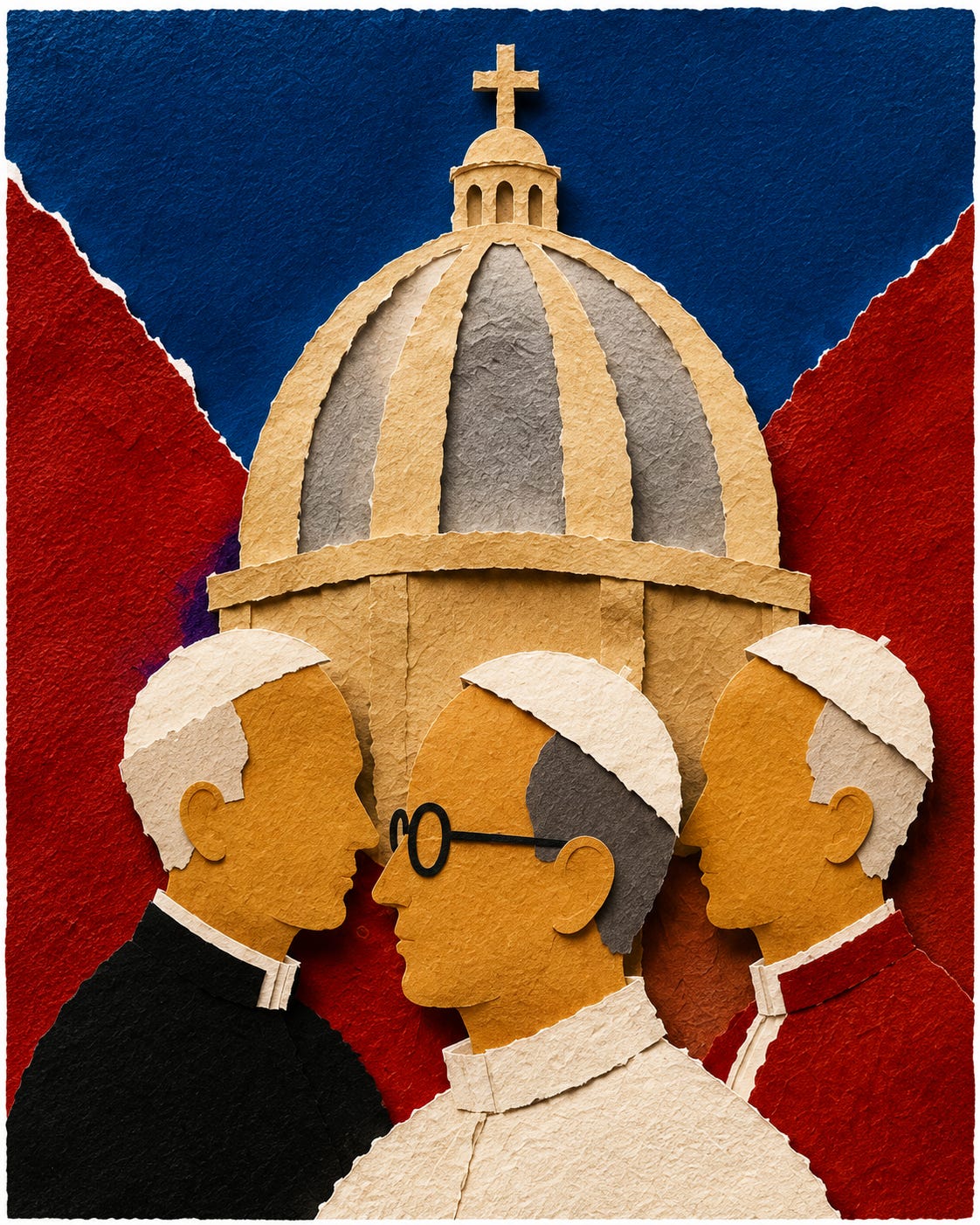
Part 3: Six Popes Have Taught the Same Doctrine
A teaching held by one pope is that pope’s emphasis. A teaching held by six consecutive popes, across nearly sixty years, through every shift in theology and politics the Church has weathered since the Council, is something else. Integral human development belongs to the second category. The popes who developed it disagreed about liturgy, authority, sexual ethics, and the pace of reform. On the social mission of the Church, they spoke with one voice.
The Popes Who Taught It Shared Little Else
Consider the range. Paul VI was the architect of the post-Vatican II reforms, the pope who remade the liturgy and reoriented the Church toward the modern world. John Paul II was a fierce anti-communist, a defender of Humanae Vitae, a champion of traditional sexual morality who disciplined liberation theologians. Benedict XVI was the theological conservative who restored older liturgical forms and spent his career resisting what he called the dictatorship of relativism. Francis was the Latin American Jesuit who elevated the peripheries, denounced market fundamentalism, and alarmed traditionalists. Leo XIV is the American Augustinian missionary, elected by a College of Cardinals divided between Francis’s appointees and their opponents.
These men did not form a faction. They represented every major current in the modern Church, and several of them spent considerable energy correcting one another’s emphases. A teaching they all affirmed cannot be dismissed as the property of one wing.
Each Pope Extended the Teaching Into New Territory
Each pope added to what he inherited.
John Paul II issued Sollicitudo Rei Socialis in 1987 to mark the twentieth anniversary of Populorum Progressio. He reaffirmed integral human development as the Church’s standard for evaluating social progress and condemned both unbridled capitalism and atheistic communism for failing to serve it -- a symmetrical judgment that refused to let the Church be claimed by either Cold War camp.
Benedict XVI published Caritas in Veritate in 2009, in the wake of the global financial crisis. He called Populorum Progressio “the Rerum Novarum of the present age,” placing Paul VI’s encyclical alongside the foundational document of modern Catholic social teaching. And he made the strongest claim any pope had made for integral human development: “the whole Church, in all her being and acting -- when she proclaims, when she celebrates, when she performs works of charity -- is engaged in promoting integral human development.”
Francis carried the concept into terrain earlier popes had not mapped. Laudato Si’ (2015) integrated care for creation, arguing that the cry of the earth and the cry of the poor are one cry, and that authentic development must be an integral ecology. Fratelli Tutti (2020) extended the principle to universal fraternity across borders. His final encyclical, Dilexit Nos (2024), grounded the whole social mission in the love of the heart of Christ, connecting contemplation to action.
Benedict’s Claim Rules Out Treating Integral Human Development as Optional
Benedict’s formulation deserves a second look, because it forecloses a common evasion. He did not say that some Catholics, or some Vatican offices, or some politically engaged believers promote integral human development. He said the whole Church, in all her being and acting, is engaged in it. Proclamation, worship, and charity all serve the same end.
On Benedict’s account, a Catholic cannot treat integral human development as a special interest belonging to the social-justice wing of the Church while the real business of faith goes on elsewhere. The Church’s social mission is the Church’s own life seen under one of its essential aspects, not an activity running alongside it.
The Agreement of Adversaries Is the Strongest Evidence
When people who disagree about nearly everything nonetheless agree about one thing, their agreement carries unusual weight. They have no shared bias to explain it away. Paul VI and Benedict XVI read the Council differently. John Paul II and Francis approached economics and the poor with different instincts and different vocabularies. Leo XIV was elected by cardinals who could not agree on what kind of pope they wanted.
Yet on the proposition that the measure of every social arrangement is whether it serves the complete good of every person, all six converge. When adversaries converge, no shared bias explains it away, and their agreement marks the difference between settled doctrine and partisan preference. Integral human development falls on the settled side.
______
This essay is part of a ten part series on Optimizing Integral Human Development -- Understanding the Social Mission of the Catholic Church.
The individual parts of the series are:
Part One: The Two Leos, 135 Years Apart
Part Two: Integral Human Development Is 2,400 Years Old
Part Three: Six Popes Have Taught the Same Doctrine
Part Four: The Church Reorganized Itself Around the Idea of Integral Human Development
Part Five: The Dimensions of Integral Human Development
Part Six: What Integral Human Development Rejects
Part Seven: Integral Human Development in the Age of Artificial Intelligence
Part Eight: The Attack on Empathy
Part Nine: Catholic Against Catholicism
Part Ten: What Integral Human Development Requires of Us Now