Optimizing Integral Human Development: Understanding the Social Mission of the Catholic Church -- Introduction and Part 1
Part 1 of a ten-part series on the social mission of the Catholic Church

Introduction
The single idea has organized all of the social teaching of the Catholic Church for more than a century is that the measure of any society is whether it serves the good of the whole person and of every person. The Church has given a complex but beautiful name for this idea: integral human development. In May 2026, in his first encyclical, Magnifica Humanitas, Pope Leo XIV made that idea the core Catholic standard by which all human social organizations, institutions, and technologies must be understood and judged, and applied it to artificial intelligence.
The chapters that follow show this doctrine of integral human development, as articulated by Pope Leo XIV in Magnifica Humanitas, is the settled social doctrine of the Catholic Church, taught by a long line of popes across more than a century, as the standard for social justice that stands above every partisan political party or ideology.
As we will show, while the term integral human development might sound new, the idea itself is ancient -- it runs from Aristotle’s account of human flourishing through Thomas Aquinas, who ordered that flourishing toward God, to Jacques Maritain, who set it against the totalitarian ideologies of the 1930s, to the Second Vatican Council, which placed the human person at the center of the Church’s engagement with the modern world. Paul VI gave the idea its name in 1967, defining authentic development as “the good of every man and of the whole man.” From Paul VI through Leo XIV, six consecutive popes taught it across nearly sixty years.
Leo XIV warns in Magnifica Humanitas against an ideology that assigns greater worth to the more efficient and treats the person as a resource to be used. The social mission of the Catholic Church is to optimize integral human development by helping to create societies ordered to the flourishing of every person.
Part 1: The Two Leos, 135 Years Apart
This is Part 1 of Optimizing Integral Human Development, a ten-part series on the social mission of the Catholic Church. This installment shows how Leo XIV, by taking his name and dating his first encyclical to the anniversary of Rerum Novarum, claimed the inheritance of Leo XIII and modern Catholic social teaching.
On May 25, 2026, Pope Leo XIV released his first encyclical, Magnifica Humanitas -- “Magnificent Humanity” -- on safeguarding the human person in the time of artificial intelligence. He signed it on May 15, the 135th anniversary of Rerum Novarum, the 1891 encyclical of Pope Leo XIII that launched modern Catholic social teaching.
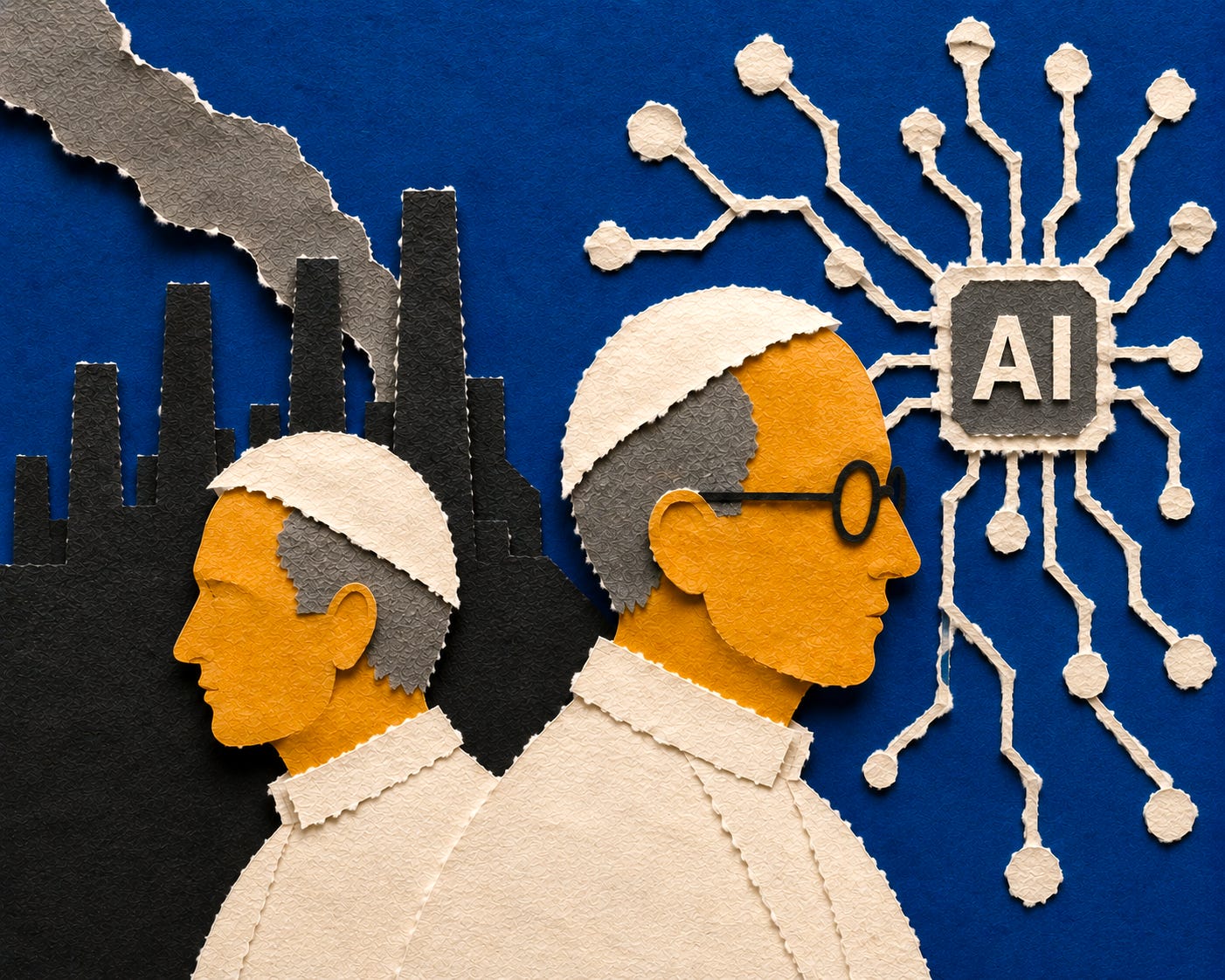
Cardinal Robert Francis Prevost took the name Leo, and signed on that anniversary, to reach past more than a century of popes and claim a particular inheritance. Leo XIII had confronted the Industrial Revolution -- a machine age that was tearing workers from the land, crowding them into factories, and reducing human beings to units of production. Leo XIV faces a machine age of a different kind. At the presentation of the encyclical at the Vatican, he made the connection explicit: “Like the earlier Leo, I feel entrusted to look upon another huge transformation with eyes of faith, with lucidity of reason, with openness to mystery, and with cries of the poor and the earth resounding in my heart.” The choice of name announced that he would meet the digital revolution with the resources Leo XIII had used: the Gospel, human reason, and the dignity of the person.
A word about the document itself. Magnifica Humanitas is the first encyclical of Leo XIV’s pontificate, an exercise of the Church’s highest ordinary teaching authority, released in May 2026. It reads artificial intelligence through the inheritance of Catholic social teaching, and it places itself deliberately in the line of social encyclicals that runs from Rerum Novarum through Paul VI, John Paul II, Benedict XVI, and Francis. That placement is the argument of this opening chapter.
The Industrial Revolution Produced the First Great Social Encyclical
When Leo XIII wrote in 1891, European and American society was being remade by industrial capitalism. Workers labored long hours for low wages in dangerous conditions. Capital concentrated in fewer hands. Whole populations moved from farms to slums. Socialism offered one answer -- abolish private property, let the state own the means of production. Unregulated capitalism offered another -- let the market sort everything out, unburdened by moral constraint.
Leo XIII rejected both. Workers possess a dignity that no employer and no state confers, because that dignity flows from their creation in the image of God. From dignity come rights: to a just wage, to rest, to form associations, to own property, to be treated as persons rather than instruments. The state has a duty to protect the weak against exploitation by the strong. The market is not a self-justifying moral order.
Rerum Novarum set the pattern for everything that followed. The Catholic Church would not bless either ideology of the age. It would judge both against a prior standard -- the human person, considered whole and entire.
Artificial Intelligence Poses the Question Again
The transformation Leo XIV addresses is the rise of artificial intelligence and the digital reordering of work, knowledge, and human relationship. Like the steam engine and the factory before it, AI is reshaping how people labor, what they are paid, who holds power, and how they understand themselves. Like the machine age of 1891, the digital age arrives with its own ideologies promising salvation -- that more computing power, more data, more optimization will deliver human progress on their own.
Leo XIV answers as Leo XIII answered. No technology saves us. No economic system saves us. Human flourishing comes through the development of the whole person and of every person -- what the Church has come to call integral human development.
Integral Human Development Is the Measure the Church Applies
The phrase anchors the whole series, so I will state it plainly at the outset. Integral human development means the good of the whole person and of each person. “Each person” means no one is excluded -- not the poor, not the migrant, not the unborn, not the disabled, not the stranger. “The whole person” means every dimension of human life -- material, social, cultural, political, moral, and spiritual -- and not economics alone.
Across the chapters ahead, one claim will be defended from many angles: that integral human development is the settled social doctrine of the Catholic Church, taught consistently across more than a century, by popes who agreed on little else, embedded in the structure of the Vatican itself. It is the standard by which the Church asks Catholics to judge every economic arrangement, every political program, every social policy, and now every technology.
Magnifica Humanitas is the most recent and fullest statement of that standard. It is the occasion for this series. The idea it expresses did not begin in 2026, or in 1891. Its roots run back more than two thousand years, to a Greek philosopher’s account of what it means for a human being to flourish.
The next chapter begins there.On May 25, 2026, Pope Leo XIV released his first encyclical, Magnifica Humanitas -- “Magnificent Humanity” -- on safeguarding the human person in the time of artificial intelligence. He signed it on May 15, the 135th anniversary of Rerum Novarum, the 1891 encyclical of Pope Leo XIII that launched modern Catholic social teaching.
Cardinal Robert Francis Prevost took the name Leo, and signed on that anniversary, to reach past more than a century of popes and claim a particular inheritance. Leo XIII had confronted the Industrial Revolution -- a machine age that was tearing workers from the land, crowding them into factories, and reducing human beings to units of production. Leo XIV faces a machine age of a different kind. At the presentation of the encyclical at the Vatican, he made the connection explicit: “Like the earlier Leo, I feel entrusted to look upon another huge transformation with eyes of faith, with lucidity of reason, with openness to mystery, and with cries of the poor and the earth resounding in my heart.” The choice of name announced that he would meet the digital revolution with the resources Leo XIII had used: the Gospel, human reason, and the dignity of the person.
Magnifica Humanitas is the first encyclical of Leo XIV’s pontificate, an exercise of the Church’s highest ordinary teaching authority, released in May 2026. It reads artificial intelligence through the inheritance of Catholic social teaching, and it places itself deliberately in the line of social encyclicals that runs from Rerum Novarum through Paul VI, John Paul II, Benedict XVI, and Francis.
The Industrial Revolution Produced the First Great Social Encyclical
When Leo XIII wrote in 1891, European and American society was being remade by industrial capitalism. Workers labored long hours for low wages in dangerous conditions. Capital concentrated in fewer hands. Whole populations moved from farms to slums. Socialism offered one answer -- abolish private property, let the state own the means of production. Unregulated capitalism offered another -- let the market sort everything out, unburdened by moral constraint.
Leo XIII rejected both. Workers possess a dignity that no employer and no state confers, because that dignity flows from their creation in the image of God. From dignity come rights: to a just wage, to rest, to form associations, to own property, to be treated as persons rather than instruments. The state has a duty to protect the weak against exploitation by the strong. The market is not a self-justifying moral order.
Rerum Novarum set the pattern for everything that followed. The Catholic Church would not bless either ideology of the age. It would judge both against a prior standard -- the human person, considered whole and entire.
Artificial Intelligence Poses the Question Again
The transformation Leo XIV addresses is the rise of artificial intelligence and the digital reordering of work, knowledge, and human relationship. Like the steam engine and the factory before it, AI is reshaping how people labor, what they are paid, who holds power, and how they understand themselves. Like the machine age of 1891, the digital age arrives with its own ideologies promising salvation -- that more computing power, more data, more optimization will deliver human progress on their own.
Leo XIV answers as Leo XIII answered. No technology saves us. No economic system saves us. Human flourishing comes through the development of the whole person and of every person -- what the Church has come to call integral human development.
Integral Human Development Is the Measure the Church Applies
The phrase anchors the whole series, so I will state it plainly at the outset. Integral human development means the good of the whole person and of each person. “Each person” means no one is excluded -- not the poor, not the migrant, not the unborn, not the disabled, not the stranger. “The whole person” means every dimension of human life -- material, social, cultural, political, moral, and spiritual -- and not economics alone.
Across the chapters ahead, one claim will be defended from many angles: that integral human development is the settled social doctrine of the Catholic Church, taught consistently across more than a century, by popes who agreed on little else, embedded in the structure of the Vatican itself. It is the standard by which the Church asks Catholics to judge every economic arrangement, every political program, every social policy, and now every technology.
Magnifica Humanitas is the most recent and fullest statement of that standard. It is the occasion for this series. The idea it expresses did not begin in 2026, or in 1891. Its roots run back more than two thousand years, to a Greek philosopher’s account of what it means for a human being to flourish.
The next chapter begins there.
______
This essay is part of a ten part series on Optimizing Integral Human Development -- Understanding the Social Mission of the Catholic Church.
The individual parts of the series are:
Part One: The Two Leos, 135 Years Apart
Part Two: Integral Human Development Is 2,400 Years Old
Part Three: Six Popes Have Taught the Same Doctrine
Part Four: The Church Reorganized Itself Around the Idea of Integral Human Development
Part Five: The Dimensions of Integral Human Development
Part Six: What Integral Human Development Rejects
Part Seven: Integral Human Development in the Age of Artificial Intelligence
Part Eight: The Attack on Empathy
Part Nine: Catholic Against Catholicism
Part Ten: What Integral Human Development Requires of Us Now