Integral Human Development Is 2,400 Years Old: Optimizing Integral Human Development -- Understanding the Social Mission of the Catholic Church, Part 2
Part 2 of a ten-part series on the social mission of the Catholic Church

Part 2: Integral Human Development Is 2,400 Years Old
This is Part 2 of Optimizing Integral Human Development, a ten-part series on the social mission of the Catholic Church. This installment traces the idea from Aristotle and Thomas Aquinas through Jacques Maritain to Paul VI, who gave it its name in 1967.
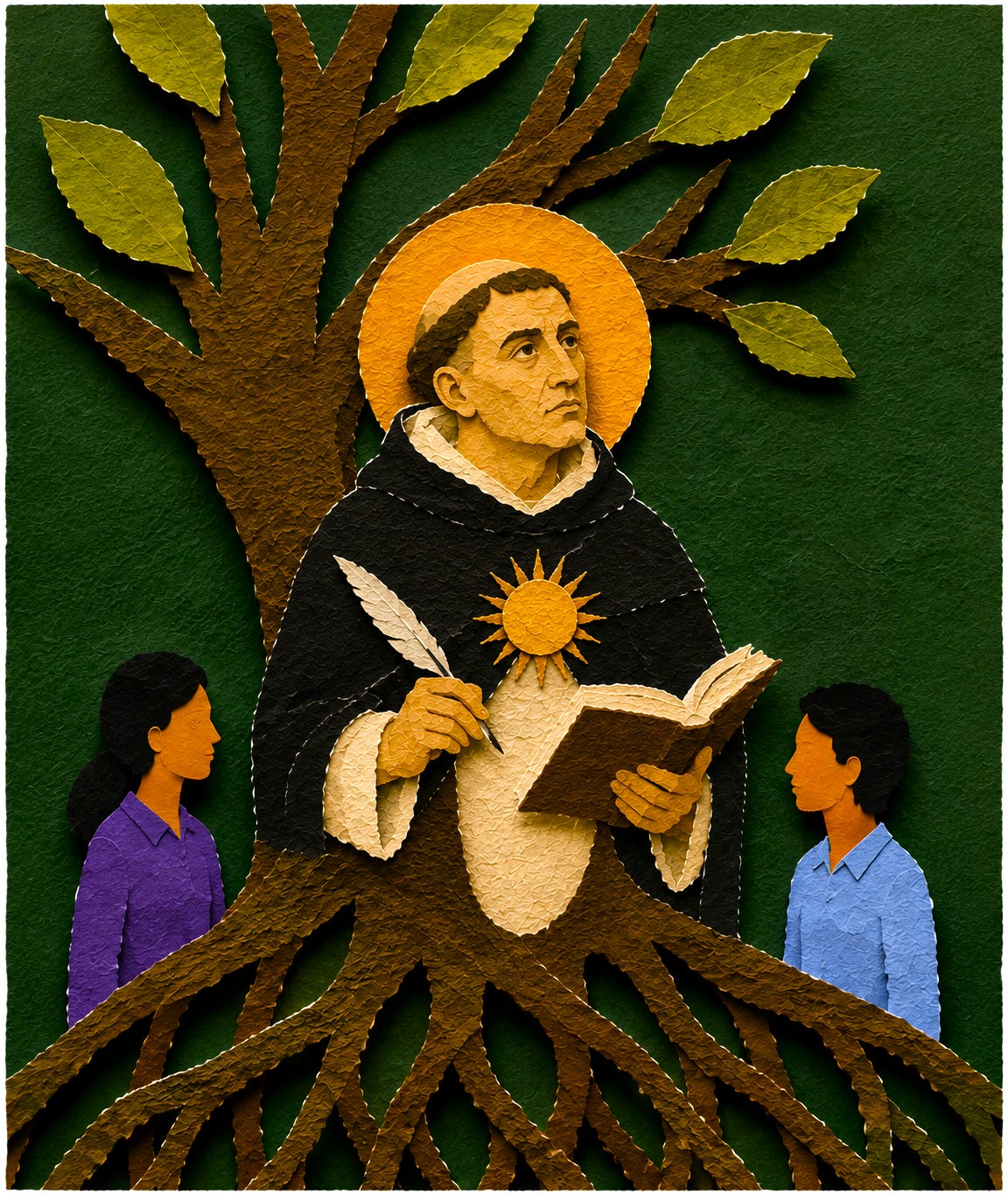
The phrase “integral human development” entered Catholic teaching in 1967. The idea behind it is far older. It descends from a Greek philosopher’s account of human flourishing, passes through the greatest synthesis in medieval theology, and reaches the twentieth century through a French philosopher who set it against the totalitarian ideologies of his day. By the time Paul VI gave the idea its name, it carried twenty-four centuries of development behind it.
Aristotle Defined Flourishing as the Human Good
Aristotle held that every living thing has an end toward which it is ordered, a fullness proper to its nature. For a human being, that end is eudaimonia -- usually translated as happiness, more accurately rendered as flourishing. Anthony Annett, author of Cathonomics, develops the concept as the gratification of right desire: the condition of a person living well, exercising the virtues, achieving the good proper to a rational and social creature. Pleasure and the satisfaction of whatever desires a person happens to have do not reach it.
Two features of Aristotle’s account carried forward into Catholic teaching. Flourishing engages the whole person, not one faculty alone. And it is achieved in community, not in isolation -- the human being is by nature a political animal, made to live among others and to pursue a common good that exceeds private advantage.
Aquinas Ordered Human Flourishing Toward God
Thomas Aquinas took up Aristotle’s account in the thirteenth century and completed it. Annett describes the result as a synthesis of classical ethics with Christian theology. Aquinas agreed that the human person is ordered toward flourishing and that flourishing requires the virtues. He added what Aristotle could not have known: that the person’s ultimate end is communion with God, and that earthly flourishing, however genuine, points beyond itself to a happiness only God can complete.
The addition mattered. It meant that no purely material or political account of human good could ever be sufficient. A person might have wealth, health, culture, and freedom and still fall short of the end for which human beings are made. Flourishing without openness to the transcendent is truncated flourishing.
Maritain Set Integral Humanism Against the Ideologies of the 1930s
The Aristotelian-Thomistic account survived in Catholic philosophy for centuries. In 1936, the French philosopher Jacques Maritain gave it a name and a polemical edge. His book Integral Humanism argued that the modern world offered two false humanisms. Liberal capitalism reduced the person to an individual consumer pursuing private gain. Marxist collectivism reduced the person to a unit of the social whole, dissolving individual dignity into the class or the state.
Against both, Maritain proposed an integral humanism: a vision of the person as whole and entire, material and spiritual, individual and social, free and ordered toward God. Neither capitalism nor communism could deliver it, because each amputated part of the human person. Maritain’s integral humanism shaped European Christian Democracy and influenced the Catholic social thought of the next generation.
Vatican II Made the Person the Center of the Church’s Engagement with the World
When the Second Vatican Council issued its Pastoral Constitution on the Church in the Modern World, Gaudium et Spes, in 1965, it placed the human person at the center of everything. The Council declared its governing principle directly: “The pivotal point of our total presentation will be man himself, whole and entire, body and soul, heart and conscience, mind and will.”
The whole person, every dimension, nothing excluded -- the conciliar formula gathered up Aristotle, Aquinas, and Maritain and made the vision of the person whole and entire the foundation of the Church’s engagement with modern political, economic, and social life. Maritain attended the Council as a revered influence. Paul VI, who promulgated Gaudium et Spes, carried its vision into the encyclical he would issue two years later.
Paul VI Gave the Idea Its Name in 1967
In Populorum Progressio, Paul VI gave a name to the idea that had been developing for twenty-four centuries. Development, he argued, cannot be reduced to economic growth. To be authentic it must be integral -- it must promote “the good of every man and of the whole man.”
He spelled out what that meant. Less than human conditions include not only material poverty but oppressive political structures, the exploitation of workers, and the moral poverty of those crushed by their own self-love. Truly human conditions move beyond meeting material needs to the broadening of knowledge, the acquisition of culture, a growing awareness of others’ dignity, an active interest in the common good, and a desire for peace. The progression culminates in faith -- in Paul VI’s words, “God’s gift to men of good will -- and our loving unity in Christ.”
Paul VI insisted, as Aquinas had, that flourishing is not left to human option alone. Just as all creation is ordered toward its Creator, the rational creature should freely direct his life to God, the first truth and the highest good. Annett restates the definition in contemporary terms, calling integral human development the good of the whole person and all people -- a formulation that captures Paul VI’s double demand of universality (no one excluded) and completeness (every dimension of human existence engaged). What Aristotle began, Aquinas completed, and Maritain renewed became, through Paul VI, the organizing principle of the Catholic Church’s social teaching.
______
This essay is part of a ten part series on Optimizing Integral Human Development -- Understanding the Social Mission of the Catholic Church.
The individual parts of the series are:
Part One: The Two Leos, 135 Years Apart
Part Two: Integral Human Development Is 2,400 Years Old
Part Three: Six Popes Have Taught the Same Doctrine
Part Four: The Church Reorganized Itself Around the Idea of Integral Human Development
Part Five: The Dimensions of Integral Human Development
Part Six: What Integral Human Development Rejects
Part Seven: Integral Human Development in the Age of Artificial Intelligence
Part Eight: The Attack on Empathy
Part Nine: Catholic Against Catholicism
Part Ten: What Integral Human Development Requires of Us Now
I very much like this presentation of "integral human development" - "the good of the whole person and all people."
Inside our efforts to achieve this standard of measure there are many obstacles (institutions and assumptions and systems) that preclude this development. And many of these obstacles are of such long standing that they seem to hold their own authority such that many think they cannot be challenged. But 'long standing' by itself is not the criteria for the validity of so many things.
Thank you for presenting this timeline for the establishment of this standard.