Integral Human Development in the Age of Artificial Intelligence: Optimizing Integral Human Development --Understanding the Social Mission of the Catholic Church, Part 7
Part 7 of a ten-part series on the social mission of the Catholic Church

This is Part 7 of Optimizing Integral Human Development, a ten-part series on the social mission of the Catholic Church. This installment applies the standard to artificial intelligence through Leo XIV’s encyclical Magnifica Humanitas.
Magnifica Humanitas exists because Leo XIV judged artificial intelligence to be the Rerum Novarum moment of the present age, a transformation as deep as the Industrial Revolution, demanding the same quality of response. The encyclical applies the whole inheritance of Catholic social teaching to a technology that promises to remake work, knowledge, power, and the human self-understanding. Its verdict avoids both technophobia and credulity. It renders judgment by the standard of integral human development.
Leo XIV Denies That Technology Is Neutral
The encyclical opens its analysis by rejecting a common assumption. Technological innovations, including artificial intelligence, are not neutral instruments that can be turned to good or ill depending only on the user. They can foster participation and justice, or they can deepen inequality, control, and exclusion, and which they do depends on how they are designed, owned, and deployed.
The point has bite. Algorithms encode the priorities of those who build them. Platforms shape behavior through their architecture. Systems trained on past data carry forward the biases of the past. To call a technology neutral is to decline responsibility for the values built into it. Leo XIV declines the evasion.
Leo XIV Condemns Efficiency as a Measure of Human Worth
Among the ideologies of the digital age, Leo XIV singles out one as especially insidious: the belief that a person must earn or justify his own worth, with greater value assigned to those who are more efficient or more effective. On that logic, persons become means to results, resources to be used, and lose their standing as ends in themselves.
In the age of algorithmic management the danger is concrete. Productivity software tracks every keystroke. Systems rank workers by measurable output. Platforms score gig workers on speed and ratings. Hiring algorithms filter applicants by quantifiable traits. When efficiency becomes the measure of worth, the people who cannot compete on those terms -- the old, the disabled, the contemplative, the poor -- are quietly marked as expendable. Leo XIV holds that human dignity is prior to productivity and does not depend on it.
Babel and Jerusalem Frame the Choice
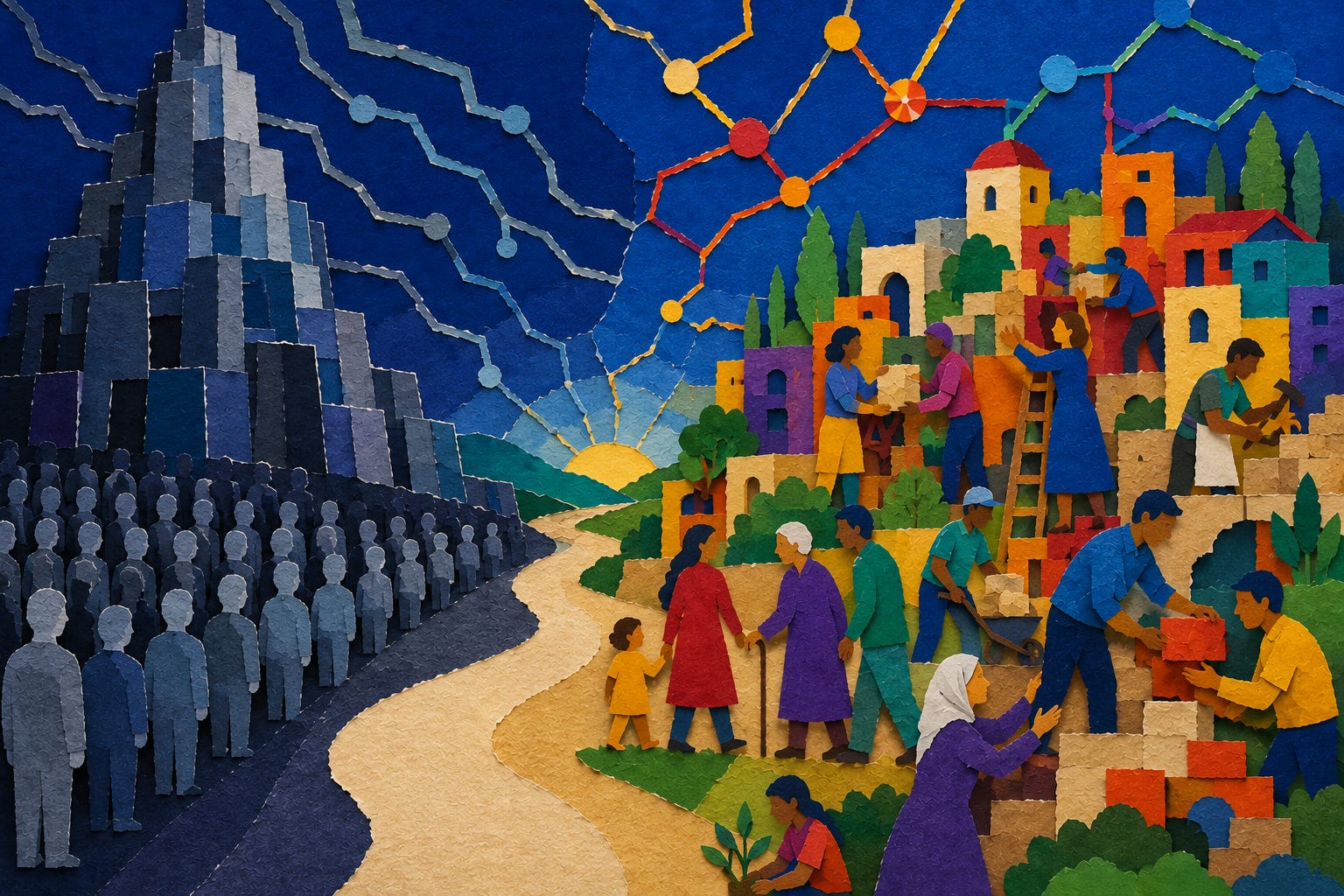
Leo XIV organizes his argument around two scenes from Scripture. The Tower of Babel was a project of impressive technical unity -- one language, one technology, one direction -- conceived without reference to God and built on the claim to self-sufficiency. Its uniformity erased difference and chose homogenization over communion, and it ended in confusion and collapse.
The rebuilding of Jerusalem under Nehemiah offers the contrary image. The city rose again not through one man’s command but through the shared work of all -- men and women, priests and artisans, householders and the young, each taking a part, the whole undertaking centered on God. Nehemiah’s Jerusalem rebuilt relationships before it rebuilt walls. Leo XIV warns against the Babel syndrome -- the idolatry of profit that sacrifices the weak, the uniformity that flattens difference, the pretense that a single digital language can translate the whole mystery of the person into data and performance.
Leo XIV Calls for Power to Be Shared
The political danger of artificial intelligence, in the encyclical’s reading, is the concentration of power in the hands of those who own the technology. Leo XIV extends the principle of the universal destination of goods to the new forms of wealth: patents, algorithms, digital platforms, technological infrastructure, and data. When the wealth of nations depends increasingly on knowledge and technology, and those goods stay concentrated in a few hands without adequate sharing, a new and grave imbalance forms.
The remedy reaches past redistributing outputs to transforming power itself -- from domination into shared responsibility. The image of Nehemiah’s Jerusalem returns: authentic development distributes agency, drawing each person into a proper role, rather than concentrating control at the top. A just digital order, the encyclical specifies, guarantees access to opportunity, protects the weakest, resists hate and misinformation, and subjects data and technology to public oversight, so that the governing principle becomes the dignity of every person rather than profit alone.
The Test Is Whether We Become More Human
German theologian Romano Guardini, quoted in Magnifica Humanitas, identified the root of the problem: contemporary humanity has not been trained to use power well. We have acquired vast capacity without acquiring the wisdom to direct it. The question artificial intelligence forces is whether the new powers serve the integral development of the human person or corrode it.
Paul VI warned in 1967 that scientific, technical, and economic progress, unless matched by authentic moral and social progress, will in the long run turn against the human person. Leo XIV applies the warning to artificial intelligence. Technological development without corresponding ethical and social progress yields an increase in means without a growth in humanity -- having more without being more. Indeed, from the perspective of integral human development, having more while being less.
______
This essay is part of a ten part series on Optimizing Integral Human Development -- Understanding the Social Mission of the Catholic Church.
The individual parts of the series are:
Part One: The Two Leos, 135 Years Apart
Part Two: Integral Human Development Is 2,400 Years Old
Part Three: Six Popes Have Taught the Same Doctrine
Part Four: The Church Reorganized Itself Around the Idea of Integral Human Development
Part Five: The Dimensions of Integral Human Development
Part Six: What Integral Human Development Rejects
Part Seven: Integral Human Development in the Age of Artificial Intelligence
Part Eight: The Attack on Empathy
Part Nine: Catholic Against Catholicism
Part Ten: What Integral Human Development Requires of Us Now