What Integral Human Development Rejects: Optimizing Integral Human Development -- Understanding the Social Mission of the Catholic Church, Part 6:
Part 6 of a ten-part series on the social mission of the Catholic Church.

This is Part 6 of Optimizing Integral Human Development, a ten-part series on the social mission of the Catholic Church. This installment marks the ideologies the standard rules out -- economic reductionism, libertarianism, collectivism, nationalism, and integralism.
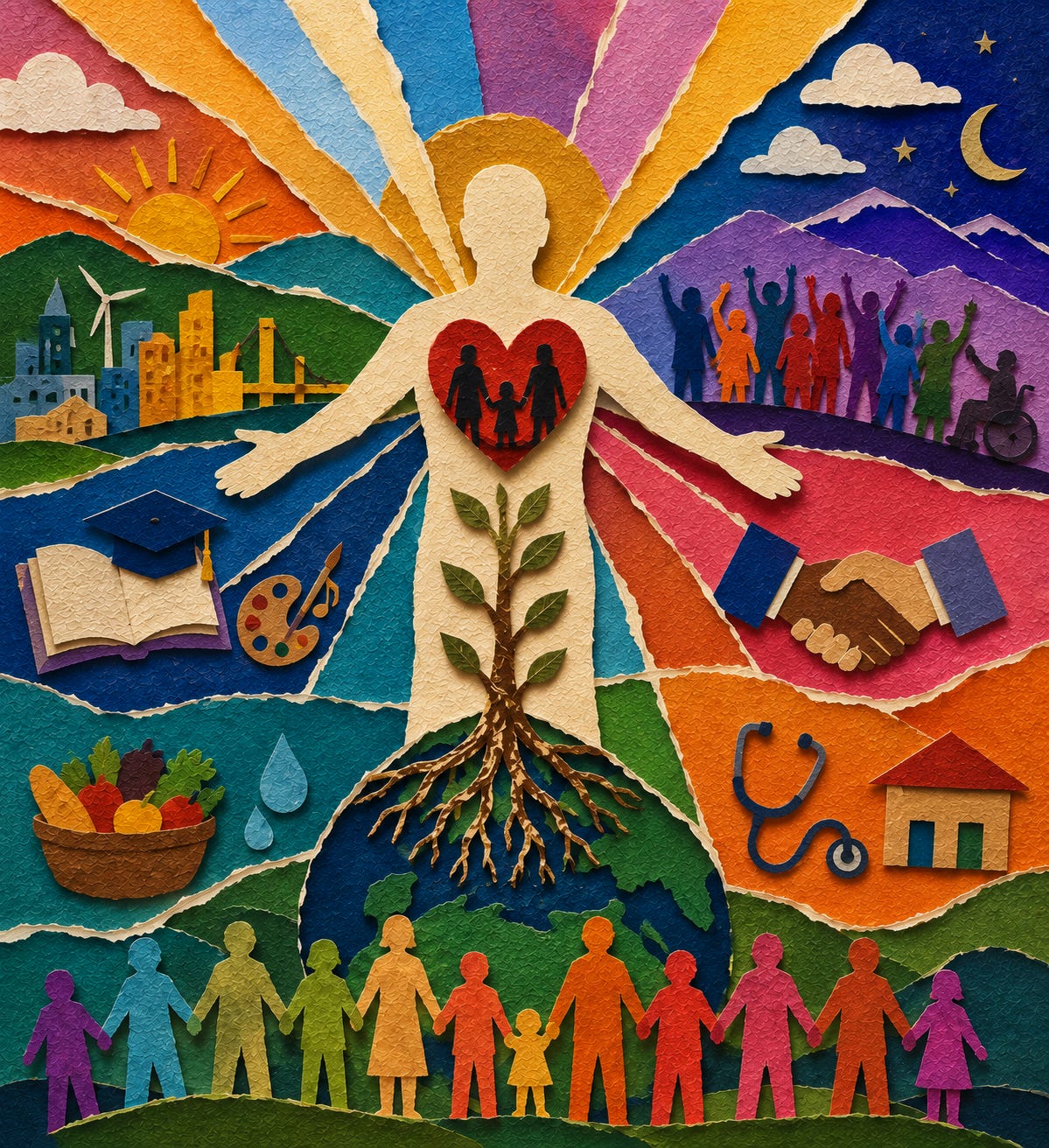
A standard that judges everything must rule some things out, or it judges nothing. Integral human development is not a vague benediction on all good intentions. By insisting on the complete human good for everyone, it condemns any arrangement that serves only some dimensions, or only some people. Several of the dominant ideologies of the present age fail the test, each in its own way.
Economic Reductionism Mistakes Growth for Development
The most widespread error treats economic growth as the whole of development. On that view, a rising gross domestic product is the measure of a society’s success, and what cannot be priced does not count.
Integral human development rejects the equation directly. Paul VI insisted that development cannot be limited to economic growth, and Magnifica Humanitas repeats the point: development is not truly human if it promotes consumption for some while imposing the costs on others, or if it advances the economic sphere while neglecting the spiritual, cultural, moral, and relational dimensions. A society can grow rich and fail every other test. Growth is a means, sometimes a necessary one, never the end.
Libertarianism Denies the Common Good and the Universal Destination of Goods
Economic libertarianism holds that the market, left to itself, produces the best attainable outcomes, that the state’s role should shrink to enforcing contracts and protecting property, and that individual liberty in the economic sphere is close to an absolute.
Catholic social teaching has rejected the position since its founding. Leo XIII denied that the market is a self-justifying moral order and affirmed the state’s duty to protect the weak. The principle of the universal destination of goods holds that the goods of the earth are meant for all, and that private property, though legitimate, is subordinate to that prior purpose. Solidarity binds the prosperous to the poor by obligation, not optional charity. A body of teaching built on the common good cannot accommodate an ideology that denies the common good exists.
Collectivism Dissolves the Person Into the State
Collectivism makes the opposite error, subordinating the person to the class, the party, or the state and treating individual dignity as something to be sacrificed for the whole. Marxist communism is the clearest historical form, and John Paul II, who had lived under it, condemned it without qualification. The condemnation is symmetrical with the rejection of unbridled capitalism. Where libertarianism dissolves society into a collection of self-seeking individuals, collectivism dissolves the individual into the mass. Both amputate part of the person. Maritain framed his integral humanism precisely against the twin reductions, and Catholic social teaching has held the double rejection ever since.
Nationalism Ranks Human Beings by Birthplace
Nationalism places the nation above the universal human family. It treats the dignity and rights of outsiders as secondary to the interests of citizens, and in its harder forms it justifies excluding, expelling, or abandoning those born on the wrong side of a border.
Integral human development rejects the subordination at its root. The standard concerns every person, with no exception for nationality. Paul VI taught that the goods of the earth belong to all humanity, not only to those born within particular borders. Francis built migration into the institutional structure of the Church’s social mission. Two concrete forms fall under the same judgment: the racism that sorts persons by blood or ethnicity, and the Christian nationalism that fuses the Gospel with the flag and sets the citizen above the stranger. A teaching that begins with “each person, excluding no one” cannot accommodate an ideology that ranks human beings by passport.
Integralism Tries to Coerce What Only Freedom Can Produce
A different error comes from within the Church. Integralism holds that the state should enforce Catholic doctrine through law, suppress religious error, and fuse civil and ecclesiastical authority into a confessional state. Some traditionalist Catholics, observing that integral human development is binding teaching, conclude that the state should therefore impose it.
The conclusion mistakes the nature of the goal. The spiritual, moral, and relational dimensions of development require freedom by their very nature. Coerced worship is not worship. Forced virtue is not virtue. A faith imposed by the state is not the free assent to God that Aquinas and Paul VI described as the person’s highest act. Paul VI affirmed in Populorum Progressio that the Church and the state are distinct powers, each supreme in its own sphere. A society cannot be coerced into integral human development, because coercion destroys the freedom its deepest dimensions require.
Rejecting integralism leaves Catholic social teaching fully engaged in politics. Catholic social teaching binds the conscience of every Catholic and bears directly on how Catholics vote, advocate, and shape policy. What it forbids is theocratic enforcement, not political engagement.
Every Ideology Is Measured, None Is Endorsed
The same logic runs through every one of these rejections. Integral human development aligns with no secular ideology, left or right. It judges each by a prior standard and finds each wanting at the point where it amputates some dimension of the person or excludes some portion of humanity. A Catholic whose politics map perfectly onto any existing ideological program has almost certainly stopped letting the standard do its work.
______
This essay is part of a ten part series on Optimizing Integral Human Development -- Understanding the Social Mission of the Catholic Church.
The individual parts of the series are:
Part One: The Two Leos, 135 Years Apart
Part Two: Integral Human Development Is 2,400 Years Old
Part Three: Six Popes Have Taught the Same Doctrine
Part Four: The Church Reorganized Itself Around the Idea of Integral Human Development
Part Five: The Dimensions of Integral Human Development
Part Six: What Integral Human Development Rejects
Part Seven: Integral Human Development in the Age of Artificial Intelligence
Part Eight: The Attack on Empathy
Part Nine: Catholic Against Catholicism
Part Ten: What Integral Human Development Requires of Us Now