J.D. Vance's Memior "Communion" Stages a Come-to-Jesus Conversion Story Performed For Evangelicals
Christ is not on the Cross. He’s strong, and white, and his mother is never around.

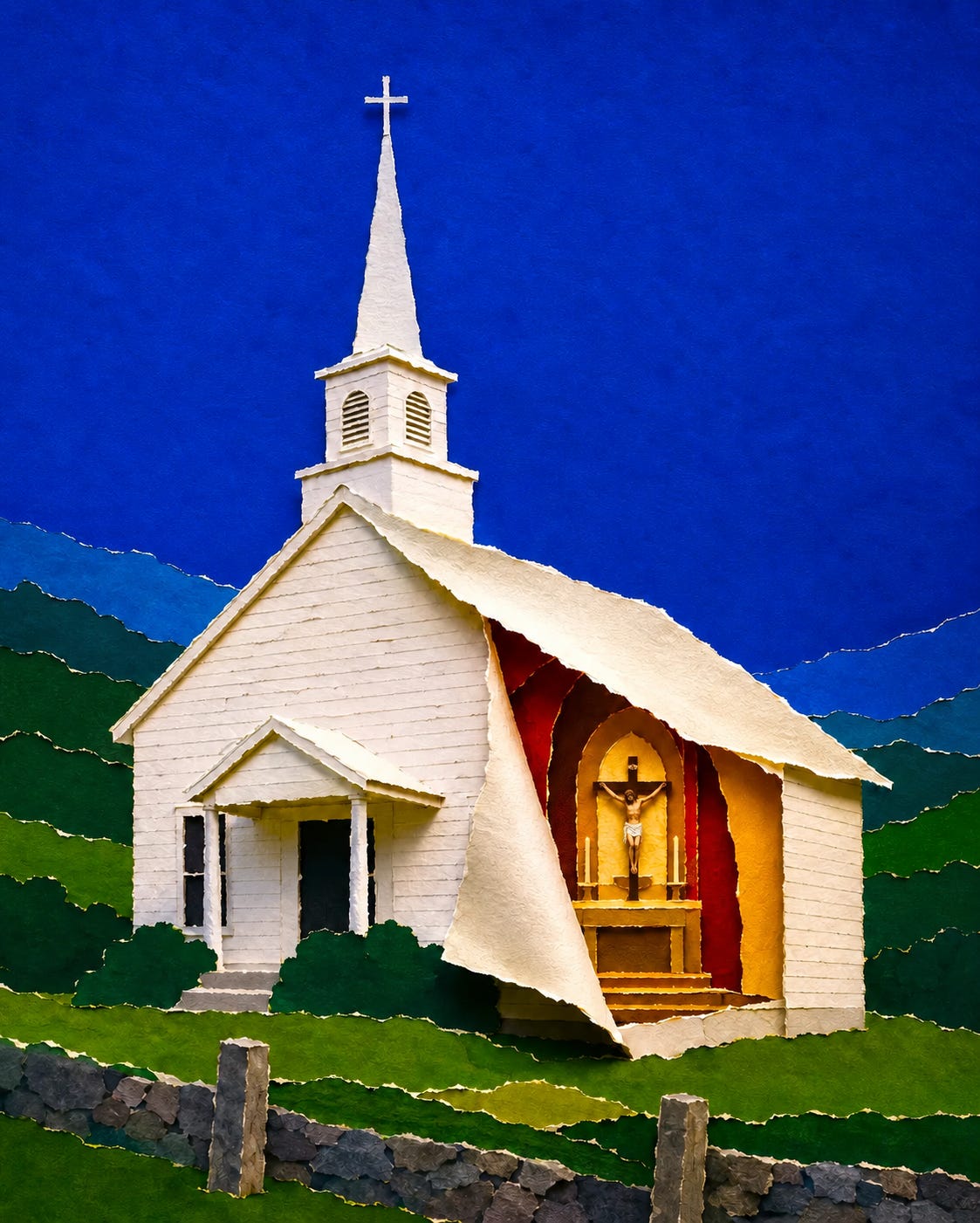
In his new book Communion: Finding My Way Back to Faith (2026), as well as in his earlier accounts of his religious transformation, J.D. Vance has staged his conversion to Catholicism as a carefully built performance that showcases his come-to-Jesus bona fides for Evangelicals while keeping Christ off the cross and his mother hidden.
He receives the Eucharist behind closed doors. The crucified body, the Mass that lays the Lord on the altar, Christ’s Virgin Mother that Vance’s Protestant grandmother was raised to fear — are downplayed or explained in language that is Protestant-facing and apologetic. What reaches that audience is the conversion story alone, a familiar Evangelical trope, the lost boy and the wilderness years and the road home, carried in the Kentucky accent of Mamaw, the Catholic-fearing grandmother who raised him.
What Vance offers his readers is a conversion story that the Evangelical eye can rest on without flinching at the sight of Romanism. The front cover illustration of Communion makes the performance visible before a reader opens the book. A volume about becoming Catholic leads with an image of a small and simple rural Protestant church. No basilica, no crucifix, no monstrance raised in gold. Instead, a white wooden Methodist meetinghouse stands in the Virginia hills, the kind of clapboard chapel that announces itself as fully American and safe from the iconography and ornamentation that American Protestants have historically found foreign and repellent about Catholicism.
The building is Mount Zion United Methodist Church in Elk Creek, a congregation of seventeen on a good Sunday, photographed as a stock photo by Tim Pennington and once used in a Babylon Bee joke about a church too small to hold more than one service. HarperCollins picked the photograph, and a designer reaching for a stock image of Americana most likely never weighed the denomination. The accident gives the game away, because it performs the book in miniature. A book about a Catholic conversion arrives in Methodist gloss before the reader even opens page one.
The dull question about Vance asks whether his faith is sincere. No text can answer it, the asking invites mind-reading, and a hostile reader waves the whole inquiry away as a slur. The useful question stays on the record, where documents settle it.
The case rests on what Vance chose to say and what he chose to mute, and any reader can check both. It makes no claim about his soul, and lays out a performance the documents already record.
Vance first wrote about his Catholic conversion in 2020 in The Lamp, a Catholic literary magazine, under the title “How I Joined the Resistance.” One worry drives the piece from the first page. Would his grandmother, the Mamaw of Hillbilly Elegy, a Kentucky woman who loved Jesus and spat at organized religion — and who believed that when the Antichrist arrived, he would be a Catholic — have forgiven him for going over to the Catholics? Vance settles the worry by deciding that despite Mamaw’s own prejudice, the Catholic Church is the closest expression of Mamaw’s kind of Christianity — that is, a Christianity in which rugged personal virtue is rooted in a deep commitment to defending the social structure of the family.
From there he works through the old anti-Catholic charges the way a defense lawyer works through counts he means to get dismissed. He raises the accusation that Catholics worship Mary, then knocks it down. He defends the authority of the Church as the cure for the chaos he watched in Protestant friends who could not agree on what a single verse meant. He dangles continuity with the Church Fathers in front of the Protestant hunger for the pure early church. Each move speaks to Protestants in the accent they understand and trust.
The heart of the essay beats in Evangelical time. The gospel Vance credits to Mamaw runs on three words, sin and redemption and grace, the themes of a revival tent meeting. The image of the Christ he follows is not the tortured Jesus nailed to the Cross that stands behind the altar of Catholic churches, but a 1940 illustration by Warner Sallman of Jesus, ubiquitous in Protestant America, as a strong and healthy white man with blue eyes and wavy brown hair, looking boldly at the future. He writes that the Sallman print hung near his childhood bedroom, and he contrasts its image of intimacy, kindness, and warmth with what he calls the distant and unapproachable Catholic Christ who “floated high above you, as a grown man or a baby, wreathed in beams of light and crowned like a king.” When Vance reaches for Scripture, he quotes Paul to the Philippians in the King James Bible. The shape of the whole conversion story is the same as the Evangelical testimony that Billy Graham preached to stadiums: faith lost, a wandering in the dark, a turning, a life made new.
When Vance lists his teachers, St. Augustine is the lone Catholic teacher among them. Significantly, the Augustine that Vance describes as his teacher is the Augustine who is most attractive to Protestants and the Augustine that the Protestant Reformation claimed as its own — the social critic of City of God who lashed out at the appetites of imperial Rome and the careful reader of Genesis who warned Christians against making fools of themselves before science. It’s the Augustine that Luther claimed as his teacher and that Calvin quoted more than any other Church father.
It is also significant that Vance credits the scapegoat theory of René Girard with cracking his unbelief. Vance was introduced to Girard through Peter Thiel, the Silicon Valley financier, who is not Catholic and who lectures in an apocalyptic Protestant style on the coming of the Antichrist. Girard is not a Catholic saint or a theologian that the Church teaches. Rather, Girard’s account of the scapegoat strains against the Catholic conviction that the Mass makes Calvary present again, and Catholic theologians have rejected his theory on exactly that ground.
If you search the public record from 2020 to 2026 for a word from Vance on the parts of Catholicism that most offend Evangelical Christianity, a wide silence opens up. On the Virgin Mary, on the rosary, on the prayers to the saints, on the Mass as the sacrifice of Calvary, on the power of the sacrament of reconciliation, the searchable mass of his interviews and essays and speeches holds no profession at all.
Pressed in plain terms on why he is Catholic, Vance reaches for rootedness. He told CBS Sunday Morning on June 14 that the Church felt rooted, that in a foreign country he would follow the Mass without the language, that he liked belonging to something that held still. He praised the Evangelicalism he left for its warmth and its welcome. Given a national stage days before his book shipped, and asked to say what his Catholic faith is, Vance described the comfort of a familiar room. He said nothing of the body of God on the altar.
Vance received his first Communion in the Dominican chapel in 2019. He told CBS that priests come to say Mass in his home and that he slips into small, quiet churches, and he called the private Mass one of the rare privileges of his office. In October 2025 he knelt before the Stone of Anointing in the Church of the Holy Sepulchre, prayed at the altar of Calvary, and carried fire from the tomb of Christ back to Washington. The man practices what he will not preach.
Two facts pin that scene down. It unfolded abroad, on a state visit, at the ground every Christian communion shares, with Greek and Armenian Orthodox clergy at his shoulder, where kneeling and candles read as broad Christian pilgrimage and not as the devotion that splits Protestant from Catholic. And it kept its eyes on Christ alone. Vance knelt at the tomb and lit his candles at Calvary. He told no bead and bent at no shrine of the Virgin. His richest public act of devotion still walked around the Mother of God, who marks the border Evangelical Christianity will not cross.
The whole pattern tightens to a single shape. Vance receives the Eucharist and clears it from the public stage. He downplays the Catholic sights that would frighten an Evangelical room, and downplays those alone. When Vance does treat the Real Presence, he opens with a skeptic's gibe — "Doesn't that make you a cannibal?" — and answers in an apologetic key, leading with what Catholics do not believe, that the bread takes on "the material properties of human flesh," before what they do. He explains the doctrine through a Protestant's incredulity. He glosses it in the Evangelical register as "one of the most powerful means of receiving God's grace," the language of personal benefit rather than sacrifice.
Vance told CBS Sunday Morning that he prefers to leave the house and go to church, that he keeps the home Mass for a late day at work or a crisis at the White House, and that he tries not to lean on it because the ease of it makes him lazy. Usha Vance called it a perk. The honest reading grants him the full quote: the household Mass is his occasional convenience, not his Sunday rule, and he half-disclaims it even as he enjoys it.
The convenience still strips the Mass of something the Church teaches belongs to its nature. The Second Vatican Council, in the Constitution on the Sacred Liturgy, set down the principle in one line that Cyprian of Carthage had taught in the third century. “Liturgical services are not private functions, but are celebrations of the Church, the holy people united and ordered under their bishops,” the Council wrote, and so they “pertain to the whole Body of the Church.” Pius XII had laid the ground in 1947, calling the liturgy the worship of the whole Mystical Body, Head and members. John Paul II said it again in 2003. The teaching runs in a straight line, and it holds that the Mass belongs to the gathered people.
The Council pressed the point one step further, and the word it chose lands on Vance. A rite meant for the assembly, it taught, “is to be preferred, so far as possible, to a celebration that is individual and quasi-private,” and the preference “applies with especial force to the celebration of Mass.” The Council placed this norm under a heading that calls the communal character part of “the hierarchic and communal nature of the Liturgy.” The assembly is not the decoration around the Mass. The Council teaches it as an essential part of what the Mass is.
The arrangement carries a canonical question that the public record leaves open. A priest may celebrate Mass outside a sacred place, canon 932 holds, only when necessity requires it, and the necessity the canonists picture is the missionary in remote country, the chaplain at the front, or the priest in a land where the faith is outlawed and the churches are watched. The provision was written for Catholics who cannot reach a church. The authority over Mass at Vance’s official residence belongs to the bishop of the place, Cardinal Robert McElroy, installed as archbishop of Washington in 2025 and the administration’s most outspoken critic in the American hierarchy. Who the celebrants are, what the chancery knows, and what has been authorized, none of it appears anywhere in the record. The man who has publicly suggested the pope tread carefully on matters of theology conducts his own sacramental life through priests no one has named and by arrangements no one has described.
The Church keeps a name for the Catholic who receives at home because he cannot come to the assembly: the sick, the homebound, the dying who are brought Communion in their rooms. That provision grieves the separation it serves and works to end it. The household Mass said for the great personage in his own residence belongs to a different history, the chapel of the prince who does not stand in the common pew. The liturgical reform of the Council set itself against that privatization of worship by rank. The distinction marks the rite, and judges no one’s soul: one form answers a deprivation the Church laments, and the other answers a convenience of office.
We can and should compare Vance’s public performance of his faith to that of John F. Kennedy, the Catholic who calmed a Protestant nation on his way to the White House.
Kennedy hid nothing about his Catholic worship. He went to Mass in the open, every Sunday, under the cameras. He kept the sacraments, took the last rites, and went to his grave from a Pontifical Requiem at the Cathedral of St. Matthew, Cardinal Cushing presiding, the whole Catholic rite carried live into American living rooms. He never edged away from Mary, the saints, or the priesthood. What Kennedy fenced off was the Church’s power over the state. Standing before the Protestant ministers of Houston in September 1960, he swore that no Catholic prelate would tell the president what to do, that he would rule in the national interest, and that he would quit the office before he let Rome run it. He handed over the political claim and let the faith stand in full sun.
The fear Kennedy faced ran against Rome the sovereign, not against the Catholic altar. Norman Vincent Peale and the ministers who massed against him in 1960 did not raise the fear that Kennedy would set the country praying to Mary. They campaigned against his Catholicism by raising the fear that the Vatican would govern the nation through him. Kennedy answered that fear and did not hide or downplay the Roman Catholicity of his worship.
Vance turns the whole arrangement inside out. He does not fence off the possibility of his faith directing his decisions in public life. Instead, he runs on it, writing a spiritual memoir, making faith his banner, preaching that his embrace of Christianity shapes how he sees family and nation and the economy. On the very question Kennedy spent a campaign disarming, Vance throws the doors open and welcomes faith into his politics. Kennedy publicly showed his Roman Catholic worship and forcefully promised a separation of faith and state. Vance announces that his faith determines his policies and downplays the Mass.
These two public presentations of their faith by Catholic politicians run in opposite directions because the politics of religion in America has changed. In 1960 the white Evangelical South still voted Democratic, and organized political Evangelicalism had not yet been born. Jerry Falwell raised the Moral Majority in 1979. The wedding of white Evangelical Christianity to the Republican Party belongs to the decades after Kennedy died. He was not wooing Evangelicals as a bloc inside his tent. He was quieting a traditional American Protestant suspicion of Catholic loyalty to Rome just enough to hold together a Democratic coalition. In contrast, Vance works inside a Republican Party whose live wire is organized white Evangelicalism, the most powerful religious bloc in the country, and a bloc whose quarrel with Catholicism aims at the worship and the doctrines, not especially at papal jurisdiction. To that audience the alien thing is the crucified body on the sacrificial altar, the dogmas of the Virgin, the rosary, the saints, the whole Catholic sacramental world of efficacious signs of grace. So Vance turns the volume up loud on his public religiosity and embrace of Christianity, while downplaying the specifics of Catholic doctrine and the specific elements of his Catholic worship. Vance is presenting a story of secular fall and Christian redemption that any Evangelical Protestant will recognize and applaud. As the publicity for Communion states, here is “an intimate account of why Vice President JD Vance strayed from the Christianity of his youth and what led him back to faith. Communion is a spiritual exploration of what it means to be a Christian in all the seasons of life JD Vance has experienced—as a child, a young man, a husband, a father, and a leader.” Vance downplays the particulars of his Catholicism from a Protestant Evangelical electorate he needs to win and that remains, at the least, deeply suspicious of and uncomfortable with Catholicism.
During the Famine in Ireland, Protestant Bible societies set up schools in which starving Catholic children were fed, on the condition of receiving Protestant religious instruction at the same time. A “souper” was a Catholic who took the soup and the bread of Protestants and, in exchange, performed the Protestant faith. The word survives for what it came to mean, the faith handed over for what a Protestant could give. In Catholic Ireland, the term was the equivalent of traitor. Vance is a kind of souper, a baptized Catholic performing his faith in a Protestant key in order to get something that anti-Catholics will not give a Catholic who is plainly and fully Roman.
The political arithmetic that Vance cares most about — and is certainly the motivation and raison d’être for his new book — is plain. White Evangelicals anchor the Republican coalition, and a Catholic who hopes to lead that coalition has every reason to be read as an Evangelical with an older and deeper pedigree, never as the candidate who answers to a bishop across the sea. A Catholicism with the Crucifix and the Virgin Mary is not a campaign asset for a Republican seeking the nation’s highest office. And so Vance keeps these in the shadows. The idiom he writes it in is Evangelical, pitched to the readers and the voters he needs. The calibration shows in what Vance carries into public and what he keeps for the private chapel. He runs on faith in his political life and explains his Catholicism there as rootedness, family, and the warmth of his grandmother’s Christianity. His Catholicism is practiced in private, or in a small wooden Methodist church. Christ is not on the Cross. He’s strong, and white, and his mother is never around.
"Vance is a kind of souper... His Catholicism is practiced in private, or in a small wooden Methodist church. Christ is not on the Cross. He’s strong, and white, and his mother is never around." Damn. What an indictment!
His first book was almost universally hated by the people in the Appalachian region he wrote about. I predict this one will be in bargain bins by the end of the year.