
The American Catholic Right answers to two authorities and neither of them is
Pope Leo XIV. One is Donald Trump, whose agenda it takes up as its own. The other is Leonard Leo, a lawyer and political power broker who holds no public office, gives few interviews, draws no crowds, and whose influence will last for decades.
Trump’s authority is political. He sets the agenda from day to day, and the Catholic Right gives him a prince’s loyalty, defending his decisions and policies as their own. Leonard Leo’s authority is the kind a pope holds: the power to set the spiritual and moral agenda, and to decide what is, and what is not, the proper Catholic response to the questions of the day. Within the world of the American Catholic Right, he is the shadow pope, holding in fact these powers over millions of American Catholics that Pope Leo XIV holds only in name.
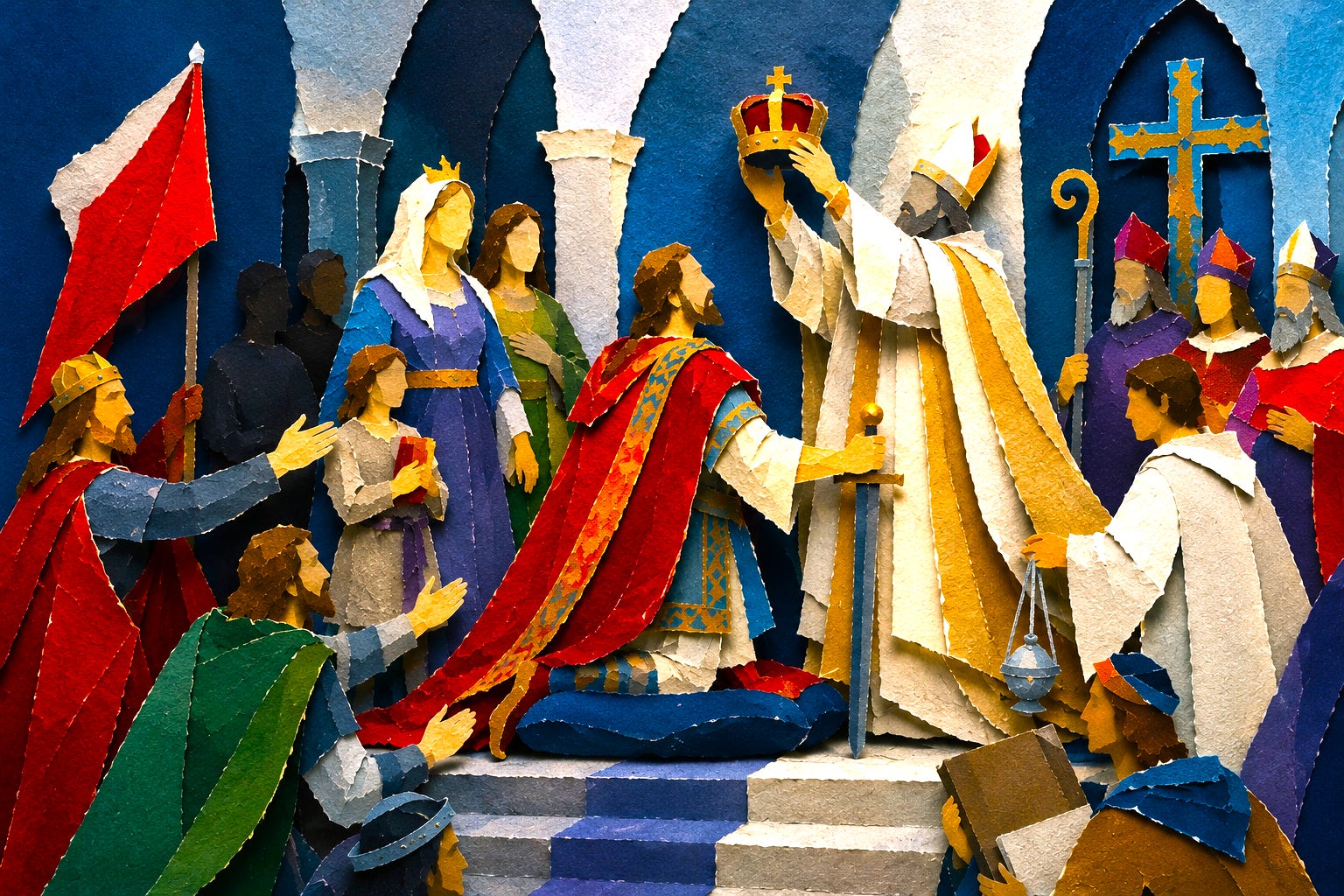
In this strategic alliance between the Catholic Right, governed by Leonard Leo, and the American state, governed by Donald Trump, the pope in Rome is meant to be irrelevant. It is Leonard Leo who stands behind Trump as Pope Leo III stood behind Charlemagne, providing the Catholic Church’s moral and religious mandate for Trump’s rule. Donald Trump and Leonard Leo need not be friends, as Charlemagne and Leo III were not, but they know they need each other to reach their grandest goals. Charlemagne offered military security while Leo III provided divine legitimacy. In the same way, Trump provides the political and military power while Leonard Leo supplies, for Catholics and others, the legal and moral justifications for the ways in which that power is used.
When I say “the Catholic Right,” I mean the organized right-wing movement that claims to speak for the Catholic Church in American politics: the donor networks and legal shops, the media outlets like EWTN and First Things and the National Catholic Register, political organizations like CatholicVote and the Catholic League, think tanks like the Napa Institute and the Acton Institute, the clergy who lend it credibility and cover, and the laity whom it forms to advance the goals of contemporary American conservatism.
Those goals include mass deportations, ending birthright citizenship, ending DEI policies, downplaying or ignoring the role slavery and racial discrimination played in American history, removing environmental restraints on capital, weakening trade unions, enforcing strict gender norms, reducing corporate taxes, and projecting American military power across the globe whenever the president chooses. It is a machine with institutions and payrolls, designed to provide a Catholic rationale for each of these goals, and perhaps more than anyone else, Leonard Leo built it and helps pay for it. It is also a machine whose goals are often in direct conflict with the Catholicism that comes from Rome.
For thirty years Leonard Leo ran the pipeline of the Federalist Society, the lawyers’ network he built from a student club into the vetting house for the American judiciary, with chapters in all accredited law schools and major cities, and tens of thousands of members. It recruits conservative law students, carries them through prestigious judicial clerkships and government posts onto the bench, and screens them for conservative poltical reliability at every step. Leo assisted Clarence Thomas through his 1991 confirmation and then ran the campaigns for John Roberts, Samuel Alito, Neil Gorsuch, Brett Kavanaugh, and Amy Coney Barrett. He drew up the Supreme Court list Donald Trump ran on in 2016, seated the three justices who built the conservative supermajority, and helped place more than two hundred judges on the federal appellate bench and the district courts. By the end of Trump’s first term, judges who he and the Federalist Society had vetted comprised quarter of the federal bench and six of the nine seats on the Supreme Court. The Court that overturned Roe v. Wade was his more than any other man’s, and so were the rulings that ended affirmative action, gutted the regulatory state, give the president sweeping power over the federal government and granted a president broad immunity from prosecution.
The money came in a single stroke. In 2021 a Chicago industrialist, Barre Seid, signed $1.6 billion over to Leonard Leo’s Marble Freedom Trust, the largest known political advocacy gift in the country’s history, and Leo came to command a war chest larger than either political party.
He moves this great stream of money as poltical influence through funds with bland names, the 85 Fund, the Concord Fund, the Rule of Law Trust, the Freedom and Opportunity Fund that gave away $250 million in a single year, routed through donor-advised accounts that bury the source, and out to two for-profit firms he controls, the BH Group and CRC Advisors, that have collected more than $135 million from his own network.
Watchdogs have charged that Leo arranged for the nonprofits he directs to enrich him personally. The Campaign for Accountability put the figure at $73 million, and the money paid off a mortgage, bought an eleven-bedroom house in Maine, and stocked a wine locker at Morton’s. He directed secret payments to Ginni Thomas, the wife of Justice Thomas, and told the go-between to keep her name off the paperwork. The District of Columbia opened an investigation and the Senate Judiciary Committee issued a subpoena; Leo defied both and denies any wrongdoing.
With the federal courts already captured, Leo turned the machine outward. His network funneled more than $50 million into the groups that wrote Project 2025, the blueprint for the second Trump administration. Through the Teneo Network, which he chairs and which he calls a Federalist Society for every field at once, he places his brand of conservative ideologues in finance, journalism, entertainment, and the universities. In 2024 he told his grantees to stop holding seminars and start waging campaigns, to turn their ideas into weapons and, in his own words, “crush liberal dominance at the choke points of influence and power in our society.” He has pledged a billion dollars to that fight. He sits on the board of governors of the Council for National Policy, a secretive umbrella organization and networking group that advocates for conservative policies, and that the New York Times has called "a little-known club of a few hundred of the most powerful conservatives in the country," who meet three times yearly behind closed doors at undisclosed locations for a confidential conference.“
Under all of it sits a chapel. Leo takes his spiritual direction at the Catholic Information Center, the Opus Dei house on K Street, where he and his wife rank among the chief donors and where the Center gave him its John Paul II New Evangelization Award in 2022. He is a knight of the Order of Malta. His money underwrites nearly all of the institutions that tell American Catholics what their faith requires of them in public: Tim Busch’s Napa Institute, the Becket Fund on whose board he sits and which he twice rescued from insolvency, the Ethics and Public Policy Center, and the Catholic press and legal shops that carry the message outward. He holds the courts, the treasury, and the culture, and his See is three blocks from the White House.
There is a spiritual logic beneath the strategy. Opus Dei, where Leo prays and takes his direction, is the prelature Josemaría Escrivá founded in 1928, and it teaches the faithful to sanctify the world by excelling in their professions and carrying the faith into the institutions of secular power. Leo built his life on that counsel: seat vetted believers in the clerkships and the courts, and then, through Teneo, in finance and media and the universities. The pipeline is Escrivá’s instruction given a war chest.
The title of the official leader of the Catholic Church is papa, father. St. Peter, whom Jesus charged three times to feed the sheep, is counted the first.
The man elected by the College of Cardinals to take up Peter’s role of leading the Church walks onto the balcony as the Holy Father and blesses a square of upturned faces. He wears his fatherhood in the open.
Leo XIV fathers the faithful in the open way the office asks. He went to Lampedusa for the drowned and he turns his face toward the stranger at the edge of the water whom no nation wants.
In contrast, Leonard Leo leads the Catholic province of the American Right from the shadows, through intermediaries and trusts and foundations and political PACs. When he bought himself a parish church in Maine, he did it through a foundation that listed only his own name.
The Catholic Church believes that a pope is chosen under the guidance of the Holy Spirit. The cardinals lock the doors, sing the Veni Creator Spiritus, and cast their ballots. The Church holds also that the cardinals remain free to choose badly. Grace works through the vote without forcing it.
Leonard Leo came to lead the Catholic province of the American Right through a conclave of one. No cardinal deliberated over Barre Seid’s gift; one industrialist in Chicago signed the check, and a shadow pope was made without a vote or a prayer. There was no white smoke, only a wire transfer.
The pope speaks as the vicar of Christ, reading the moral order of creation through the Gospel. He teaches the natural law with the cross behind him.
Leonard Leo claims the same voice. He describes his work as natural law, the natural order, “how we and the world are wired,” and rejects the word theocracy for it. He grounds the courts he built on an order he says God wrote into things.
Leonard Leo did not invent the ambition. When the American bishops measured Ronald Reagan’s economy against Catholic social teaching in their 1986 pastoral, Economic Justice for All, Michael Novak and William Simon convened a lay commission and answered it before it appeared, arguing that the faith itself blessed the free market. Stephen Schneck of the Catholic University of America called that rebuttal the start of a conservative drive to build “their own magisterium on the side.” Leonard Leo is what that drive became once it had a billion dollars behind it.
The two readings collide on the questions that decide lives. Leo XIV teaches, with the Catechism that Francis revised in 2018, that the death penalty is inadmissible; the Catholic Court Leonard Leo assembled keeps the machinery of execution running. Leo XIV teaches that the migrant’s dignity comes before the border; the Catholic Court that Leonard Leo put in power sanctions the very deportations that Rome calls inhuman. On the scaffold and on the stranger, the vicar in Rome teaches one thing and the vicar on K Street rules the other way. The American Catholic Right chooses to obey the vicar on K Street.
The pattern is larger than any single issue. The Church that spoke through the bishops’ letters of the 1980s taught a whole social Gospel at once: the union and the worker, the migrant, the poor, the condemned man, the peace of nations, and the unborn child, none of them optional. The machinery Leonard Leo built keeps the short list the Republican coalition already wanted, abortion, religious liberty, the policing of sex and gender, and lets the rest fall silent. His Becket Fund and his Ethics and Public Policy Center made religious liberty the defining Catholic cause in the federal courts, while the wage, the union, the migrant, the prisoner, and the wounded creation of Laudato Si’ dropped out of the public creed. What remains is a party platform with a Roman collar, and where the platform and the Gospel diverge, the platform wins and keeps the name.
Catholic means universal. The father of a universal Church fathers everyone, which is why Leo XIV crosses the water to the migrant outside the walls, and why the popes before him washed the feet of prisoners and Muslims. The shadow pope’s flock is a tribe. It is a donor network, the institutions of conservative power, and the narrow nation that JD Vance ranks ahead of the stranger in his ordo amoris, his order of love.
As we noted at the outset, the strategic alliance between Donald Trump, the secular ruler who provides the political and military power, and Leonard Leo, the shadow pope who supplies the legal and moral justifications for the ways in which that power is used, is not new. In the eighth century the popes, hemmed in by enemies they could not fight, turned to the Frankish kings, and the kings turned to the popes for a sanction no army could supply. Pope Stephen II crossed the Alps to anoint Pepin, and Pepin drove the Lombards from Italy and handed the pope a kingdom. Pope Leo III crowned Charlemagne emperor on Christmas Day of 800, and Charlemagne became the sword of a Christendom the pope alone could bless. The king carried the face and the muscle; the pope carried the legitimacy. Neither ruled without the other.
Trump and Leonard Leo stand in those two places. Trump supplies the face and the muscle. Leo supplies the sanction, along with the judges, the money, the priests, and the Catholic institutions. The difference between the present and its historical models is that Leonard Leo is not actually the pope. He is a shadow pope, playing the part for the American Catholic Right and for no one else.
Nor is he an antipope. The Church has known those: the rival claimants who reigned from Avignon during the Great Schism, who seized the title, split the obedience of Christendom, and could in the end be judged and deposed, because the throne they claimed was one everyone could see. Leonard Leo claims nothing. He issues no decree, declares no legitimacy, sits in no rival chair. He leaves Leo XIV in Rome with the official title and the balcony, and simply takes the obedience that belongs to the office. That is what makes him harder to resist than any antipope: there is no false claim to refute and no throne to strip, only a man whose power lasts precisely as long as some American Catholics grant it.
Trump's power ends when his term does; Leo's is built to outlast it, the way the medieval papacy crowned Charlemagne and then the emperors who followed him, the office enduring while the dynasties changed. When Trump is gone, the courts, the fortune, and the Catholic institutions remain, ready to sanction whoever comes next. And some of the men who will angle to replace Trumo, including such as Vice President JD Vance and State Department Secretary Marco Rubio, are Catholics, so the next prince would need no Protestant intermediary at all. Both men already play the part — self-described faithful Catholics who defend the movement's wars and deportations against the Catholic pope who condemns them.
But a shadow rules only where the light is blocked, and only for as long as the Church consents to stand in the dark. Leonard Leo’s authority over American Catholics is not a sacrament and cannot become one. It was not conferred in a conclave that opened by calling down the Holy Spirit; it was purchased with one man’s fortune, and what a fortune bought the faithful can refuse.
Many are refusing already. The bishops who go to the border instead of the donor gala, the priests who preach the whole Gospel and not the portion the donors will pay for, the women religious who have stood with the migrant and the condemned for a hundred years, and the lay Catholics who read Matthew 25, Rerum Novarum, Laudato Si’, and Magnifica Humanitas and hear in Pope Leo XIV the authentic voice of the Catholic Church.
Pope Leo XIV was chosen by the Holy Spirit. Leonard Leo was chosen by a wire transfer. To stand with the pope is to choose the rightful successor of Peter over the shadow pope on K Street.
Excellent work. Thank you.
So, we have Pope Leo XIV, and we have Pope K-Street I.