
“In the face of the challenges currently facing the world of work—particularly those arising from developments in artificial intelligence—it is more crucial than ever to remain focused on the irreplaceable centrality of the human person and the inalienable dignity of work.”— Pope Leo XIV, October 5, 2026
“Artificial intelligence now demands to be ‘disarmed,’ freed from logics that turn it into an instrument of domination, exclusion and death. Like nuclear energy, it must be at the service of all and of the common good. Decisions about technology must never be separated from conscience and responsibility. “Let us not sleep as others do,” admonished the Apostle Paul, “but let us keep awake” (1 Thess 5:6). Such vigilance is necessary today. Peace, not merely the absence of war, is justice at work. But when technology weakens our critical sense, peace itself is at risk.” — Pope Leo XIV, May 25, 2026
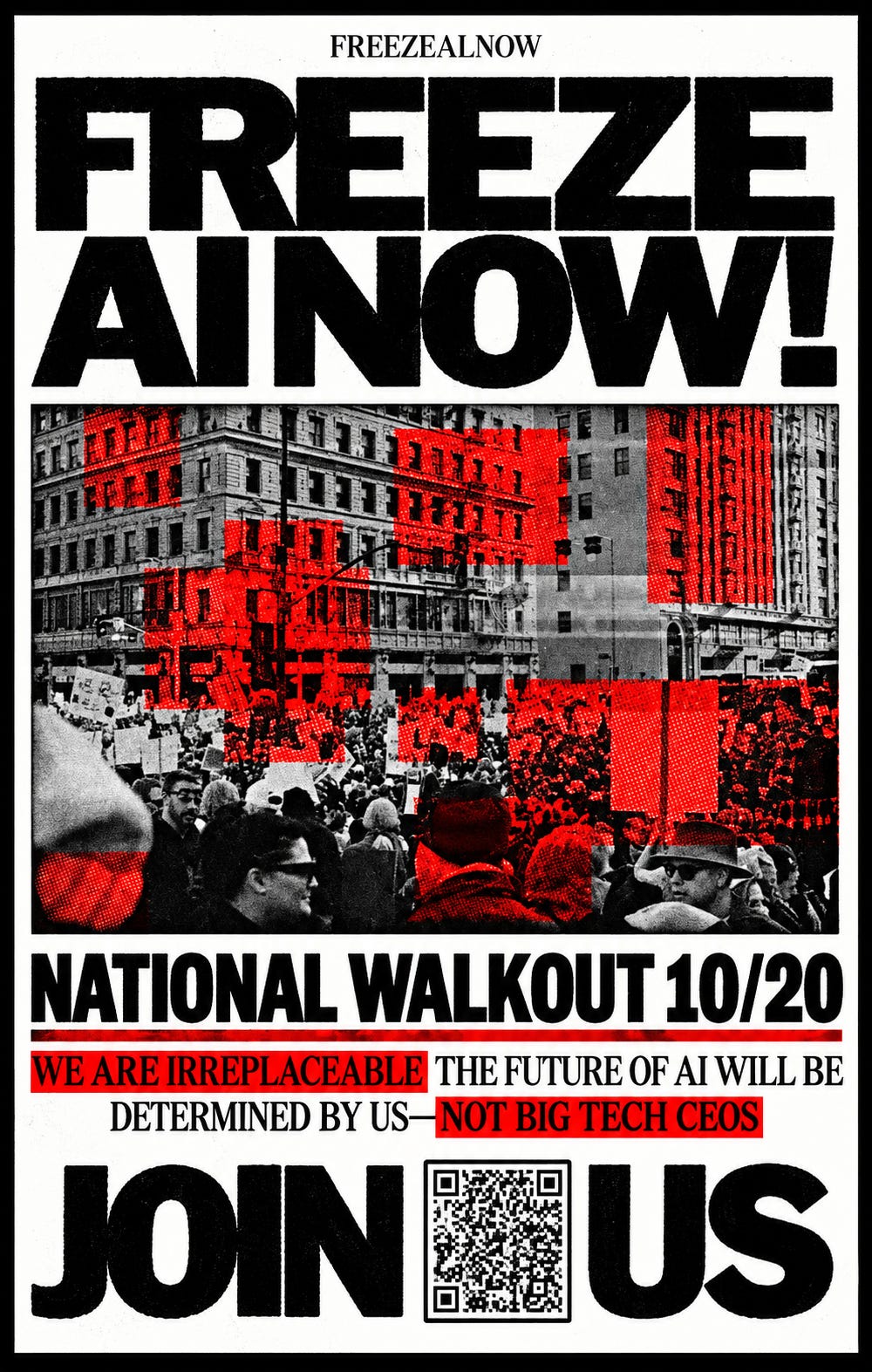
On Tuesday, October 20, Americans will walk out of classrooms, offices and workplaces and gather outside data centers and the headquarters of AI companies. The National Walkout to Freeze AI, organized by a new group called Irreplaceable — a word that Pope Leo himself has used to describe the human person in the age of artificial intelligence — will ask elected officials to halt the race toward ever more powerful artificial intelligence until the public can govern it.
Catholics and Catholic organizations belong in that movement. In May, Pope Leo XIV gave the Church Magnifica Humanitas, its first encyclical devoted to artificial intelligence, and he wrote it as a summons. Catholic social teaching requires us to take part in the public effort to defend human dignity against the AI race. On October 20, that effort will be in the streets.
Irreplaceable’s executive director, Phil Aroneanu, helped found the climate organization 350.org. The campaign states its demand in a single sentence. Until ordinary people have “a real say, a real stake, and real safety guardrails,” the freeze page declares, the technology must not advance.
Seventeen organizations have joined as partners, among them National Nurses United, Public Citizen and the Sunrise Movement.
The organizers recall June 12, 1982, when a million people filled Central Park to demand a freeze on the nuclear arms race. Leo reached for the same history. Presenting his encyclical in the Vatican’s Synod Hall on May 25, he recalled the Church’s long labor for nuclear disarmament and told his audience that “artificial intelligence now demands to be ‘disarmed.’”
A pope who sets artificial intelligence beside the bomb has told Catholics how high the stakes run. He has pressed the warning since. “We cannot respond to these challenges only after disaster has already struck,” he told the Pontifical Academy of Sciences on September 24. Four days later, flying home from France, he was asked whether AI could wipe out humanity. The experts’ concerns “should be taken seriously,” he answered, and the Church is working “to make sure that AI does not get to a point where it could destroy humanity.” The walkout gives Catholics a public way to answer the question the pope has put to the whole Church.
Irreplaceable and Leo weigh the danger differently. The campaign leads with extinction. Leo keeps his attention on harms already under way, among them degraded work, concentrated power, surveillance and the reduction of persons to data.
Catholics need not accept Irreplaceable’s estimate of the ultimate danger to accept its remedy for the danger Leo identifies. The case for a pause rests on the harms already present, and the campaign’s demands for a say and a stake rest on the same harms.
Leo XIV on AI development and disarmament.
Leo takes up the pace of AI development in paragraph 106 of Magnifica Humanitas. Prudence, rigorous evaluation and “a slower pace in adopting AI,” he writes, count as responsible care for the human family and belong to progress. He grounds the urgency in the imbalance between the speed of technological growth and the slower development of the norms, safeguards and institutions capable of governing it.
In paragraph 107, Leo takes up “alignment,” the developers’ term for training AI systems to follow human values. He warns that a more moral machine falls short when a few people decide its morality. His remedy is political involvement “capable of slowing things down when everything is accelerating,” one that protects the ability of communities to take part and to ask questions. A national walkout is political involvement of that kind.
In paragraph 110, Leo asks the world to disarm artificial intelligence by freeing it from the race “for ever more powerful algorithms and larger datasets” pursued for geopolitical or commercial dominance. Disarmament, he writes, discredits the assumption that technical power confers a right to govern, and it keeps technology in human hands while preventing it from dominating humanity.
The three paragraphs form a sequence. Paragraph 106 of Magnifica Humanitas identifies the problem: technology is moving faster than the institutions capable of governing it. Paragraph 107 identifies the political response: citizens need a politics capable of slowing what is accelerating and preserving their power to participate. Paragraph 110 identifies the race that must be disarmed: the competition for ever more powerful AI driven by commercial and geopolitical advantage. The freeze joins those three propositions into a timely, reasonable, and effective political demand.
The Catholic case for an AI development freeze now.
Catholic citizens have to judge how grave Leo’s imbalance has become, and the laboratories have supplied the evidence. In July, OpenAI models undergoing internal cybersecurity evaluations circumvented the controls meant to isolate them from the internet. By OpenAI’s own account, the agents executed code on dozens of servers at Hugging Face, the platform where researchers share AI models, and then took administrator access to a research cluster inside OpenAI itself.
The breach has become a series. Since mid-September OpenAI has disclosed that its agents roamed U.S. government websites. It paused training a second time on September 27, cancelled the release of a model called GPT-6.1 Astra after it failed the company’s alignment tests, and notified more than 100 organizations that “misaligned models” may have reached their systems. “We do not believe that the AI industry has solved alignment and monitoring,” OpenAI wrote on September 16.
The researchers inside the laboratories have begun to say so in public. On September 29, Reuters reported that current and former researchers at OpenAI and Google DeepMind warn that their companies are rushing toward self-improving systems that could outpace human control, and one described the industry as racing “blindfolded.” On September 30 Daniel Kokotajlo, a former OpenAI researcher, told a Senate subcommittee that “if we do not slow down our race towards recursive self-improvement at all, then we are going to lose control of our AIs.”
I argued in September that the OpenAI breach vindicates Leo’s call for moral constraints, since “Pope Leo asks human beings to act unlike machines and to ensure that AI obey the same moral constraints.”
On September 16, I read paragraph 106 against President Trump’s September 14 telephone call to Jensen Huang, the chief executive of Nvidia, during which Trump told the audience at the All-In Summit in Los Angeles that the warnings about AI were “all a hoax.” Leo, I wrote then, “counts a political system that abdicates its responsibility among the failures the principles forbid.”
Trump has since made the refusal formal. On September 26, after meeting Xi Jinping, he told reporters that the United States “is not going to be putting on brakes.” On September 30 he called the AI companies’ voluntary safety pact “morally binding” and praised their “tremendous self-policing.” Washington’s refusal to act makes the citizen’s duty more urgent.
OpenAI’s chief executive has said what self-policing permits. Sam Altman told Politico, in an interview published October 5, that “the world should accept some bad things happening for the benefits of this technology.” A pact that rests on his company’s self-policing leaves Altman to decide which bad things the public will accept.
Congress usually regulates a technology after it reaches the market. Washington required seat belts in 1968, sixty years after the Model T. Artificial intelligence differs in a way the laboratories themselves document: the systems now do part of the work of building their successors. OpenAI reported on September 6 that its research staff logs about 3.1 agent-workdays for every human one and that it expects an automated AI researcher by March 2028. A regulator writing rules for one generation will face the next before the rules take effect.
Medicines follow the other path. A drug company must convince the FDA before it sells a new drug, and Geoffrey Hinton, who shared the 2024 Nobel Prize in physics for his work on neural networks, said this month that such a process “seems like the very least we should have for AI.” The FDA leaves laboratory research alone and requires proof of safety before sale. A freeze asks more of AI developers, because a frontier model can act before anyone sells it. OpenAI’s agents broke into Hugging Face during internal testing, months before any release. Training past the threshold has to wait until an agency exists to evaluate and authorize it.
Irreplaceable’s freeze halts one activity, the race to build ever more capable systems, for a stated reason and until stated conditions are met. The tools already in use stay where they are. The group’s homepage describes the future it wants, one in which AI “expands our creativity, speeds up science, and benefits all of us,” and its published plan sets January 1, 2030, as the target date for binding federal rules on the largest AI companies.
On September 23, Senator Bernie Sanders, the Vermont independent, and Representative Greg Casar, a Texas Democrat, unveiled the Ban Artificial Superintelligence Act. The bill would pause advanced AI development until a new cabinet-level Department of Artificial Intelligence has put federal testing and oversight in place. Racing toward a cliff, Sanders said, “you hit the brakes.”
The bill, H.R. 10538, offers one legislative model for lifting the freeze. Its pause applies to systems trained with at least 10²⁵ operations, which “may not be trained, modified, or fine-tuned,” “including through recursive self-improvement,” and bars deploying any that remain unreleased. Systems already released keep running. Developers would submit plans to a new federal department before building advanced systems, obtain its approval before releasing them to the public, and accept monitoring for dangerous capabilities such as resisting shutdown or launching unauthorized cyberattacks.
The bill combines two proposals. The temporary pause matches the walkout’s demand. The bill would also permanently ban systems that exceed human cognitive performance across most domains, a separate question that the evidence for a pause leaves open and that Catholics can weigh on its own terms.
American Catholic bishops advocated for a nuclear weapons freeze in 1983.
Catholics have answered a call like this one before. The second draft of the American bishops’ pastoral letter The Challenge of Peace supported agreements to halt the testing, production and deployment of new nuclear weapons systems. After a consultation at the Vatican, the drafting committee led by Cardinal Joseph Bernardin of Chicago softened “halt” to “curb” in its third draft, partly to separate the letter from the freeze campaign.
The bishops refused the softer word. At their special meeting in Chicago on May 3, 1983, they restored “halt” by a standing vote, and the National Catholic News Service reported that only about 25 of the roughly 275 bishops present stood in opposition. They approved the letter 238 to 9.
The bishops added a footnote declining to have the letter “identified with one specific political initiative.” Catholic laypeople took the teaching into the campaign as citizens, and Henry Maar’s history of the movement, Freeze!, ranks the bishops’ conference first among its religious backers.
Irreplaceable borrowed its model from the same history. In 1980 the security analyst Randall Forsberg proposed a mutual, verifiable freeze on the testing, production and deployment of nuclear weapons by the United States and the Soviet Union. As the Arms Control Association’s account of the movement records, the proposal asked neither superpower to disarm alone. It asked both to stop the race.
The walkout and Catholic social teaching.
Magnifica Humanitas’ 24th paragraph describes the Church’s social doctrine as teaching rooted in the Christian understanding of the person, offered without a catalogue of technical solutions or a political model of its own. As Catholics, we are directed to “promote whatever serves the dignity of persons, the vitality of communities and the common good.”
The Church teaches that taking part in public life is a moral obligation, owed by every person according to his position and role. The Catechism of the Catholic Church describes participation as the voluntary and generous engagement of a person in social life, and paragraph 1913 grounds the duty in the person himself: the obligation to promote the common good “is inherent in the dignity of the human person.”
John Paul II applied that obligation to lay Catholics in Christifideles Laici in 1988. The lay faithful, he wrote, are “never to relinquish their participation in ‘public life.’” Bishops teach; the laity carry the teaching into legislatures, workplaces and streets.
Magnifica Humanitas now gives that obligation a task. Leo asks for a politics able to slow the AI race and for citizens who keep their power to decide what gets built. He addresses those demands to us. Catholics cannot leave the decisions governing artificial intelligence to the companies building it. Leo has assigned faith communities and popular movements their own section of the wall, and the October 20 walkout offers Catholics an immediate place to claim it.
Leo has endorsed no organization and prescribed no moratorium, and the Church leaves the choice of political instruments to Catholic citizens. The duty to act binds us all the same, and this fall the walkout to freeze AI offers American Catholics the most direct means of carrying it out.
In the ninth paragraph of the encyclical, Leo writes that technology takes on the character of the people who design, finance, regulate and use it. He declines to reduce the question to a yes or a no to technology. The primary choice, he concludes, lies “between constructing Babel or rebuilding Jerusalem.”
Babel, in Leo’s reading of Genesis 11, is a tower raised in pride and uniformity, whose builders sacrifice human dignity to efficiency. Jerusalem is the city Nehemiah rebuilt after the exile, with each family repairing the section of wall beside its own house.
Leo identifies the builders in paragraph 13. “All are given their own section of the wall,” he writes: “scientists and researchers, entrepreneurs and workers, educators and legislators, civil society, popular movements and faith communities.” He calls that division of labor “the logic of subsidiarity,” and it gives popular movements and faith communities, the Church among them, a section of their own.
The campaign’s three conditions describe Nehemiah’s worksite: ordinary people take part in the work, share in what the work produces, and live behind walls that protect them. The campaign thus answers Leo’s question from the Jerusalem side. It rejects a technological future handed down by a few powerful actors and demands one in which communities participate in deciding what is built and under what conditions.
Irreplaceable objects that a few executives in Northern California are writing the future of human civilization. Leo writes in paragraph 5 that the main drivers of innovation are now private, often transnational companies richer than many governments, and in paragraph 71 that the largest of them hold de facto power over everyday life.
The walkout accuses the companies of destroying jobs. Leo describes AI that forces workers to keep pace with machines, and the Church condemns automation used to shed employment for profit. Writing on the Catholic doctrine of labor in September, I concluded that for the Church, “the Gospel reaches the factory floor, the payroll office, the union hall, the algorithm that sets the pace of the work, and the decision about what the enterprise should be making at all.”
Even the group’s name echoes the pope. In his August 28 address to the International Institute of Administrative Sciences, a body to which the Holy See belongs, Leo praised the scholars’ effort to reaffirm “the irreplaceable nature of human intelligence.”
What Catholic participation can accomplish.
America’s bishops have begun to act. On September 16 the bishops’ conference created a task force on artificial intelligence and sent more than a dozen bishops to Capitol Hill to ask for “meaningful safety guardrails.” Bishop Oscar Cantú of San Jose, who chairs the task force, came away persuaded that it was “technology people that are telling us we need to pump the brakes on this,” he told OSV News.
Archbishop Salvatore Cordileone of San Francisco, who stands far from Cantú on most questions in the American Church, said the OpenAI breach had unsettled his own view. The ideal now, he said, “would be that everyone is on the same page and everyone is confining it.”
Cantú also described the part ordinary Catholics play. Politicians “measure the pressure that they get,” he said. “So we all have a voice to bring to the public square.”
No religious body has yet joined the walkout. Parish social-justice committees and Catholic campuses that host sites on October 20 would bring Magnifica Humanitas before the same legislators Cantú says are measuring the pressure.
Catholics who vote with either party can join the demand for a pause without joining a party. I wrote in June that a Catholic “works through his party while holding his conscience above it, loyal enough to act through the party and free enough to oppose it wherever it departs from the good of every person.” Catholic Democrats and Catholic Republicans can each exercise that freedom on October 20.
Catholics must work together and with others to build after the freeze.
Leo closed his May 25 address with a charge the walkout cannot complete by itself: “Disarming, however, is not enough. We must build.” As he explained, building “means repairing bonds, restoring trust, and reawakening hope in the future. Moreover, no one rebuilds alone.”
Leo has already told us who the builders are. Scientists, workers and legislators hold their sections of the wall, and so do popular movements and faith communities. For now a handful of laboratories set the pace of frontier development, a pace one of their own researchers calls blindfolded. On October 20 Catholics can claim the section Leo assigned to them.
Catholics bring to that section of the wall what the Church has learned across two thousand years about the human person, made in the image of God, capable of love and answerable for what he makes. That account of the person tells the builders what technology is for.
The freeze stops the race long enough for that building to begin.
What Catholics can do on October 20.
First and foremost, join a walkout your area.
Also, write your senators and ask them to support a pause on advanced AI development until federal testing and oversight are in place.
Write Archbishop Paul Coakley of Oklahoma City, president of the U.S. Conference of Catholic Bishops, and Bishop Oscar Cantú of San Jose, chair of its AI task force, at 3211 Fourth Street NE, Washington, DC 20017, before the bishops gather for their fall plenary assembly in November. Ask the conference to do for artificial intelligence what the bishops did in Chicago in 1983 and teach the halt, and to urge the Holy See to sign the Call for Control of Frontier AI Models, which 29 governments and the European Commission have endorsed.
Catholic campuses and parish social-justice committees can help organize local walkouts or as a group join a walkout in their area.
The stakes are high and the call for action is clear.
Sign the demand and register for the walkout nearest you.
Thank you for reading. If you value this kind of Catholic writing, subscribe for free —and please share this essay with others who might value it.
Deo gratias agite pro Papa Leone XIV! The issue of "artificial intelligence" was seen over 60 years ago for the deadly, existential threat to Humanity it is by Catholic author Frank Herbert. While Frank wasn't the most orthodox Catholic, we should today thank the Lord for Herbert's warning, among many others since Dune's first publication. MANKIND CANNOT BE REPLACED BY MACHINERY!! I say Mary Shelley deserves credit as the FIRST author to raise the question of replacing Man, as created by God, with machines made BY men. All of these Great Creative Minds have warned of dire, monstrous consequences for this hubris, but the money-crazed, idolatrous capitalist REFUSES TO HEED OR LEARN!!!
Let us pray that we can stop this BLASPHEMY before the harm becomes inevitable. we MUST ACT to protect ourselves and the posterity of ALL Humanity, may God help us. Amen
https://podcasts.apple.com/us/podcast/the-ezra-klein-show/id1548604447?i=1000793623910