
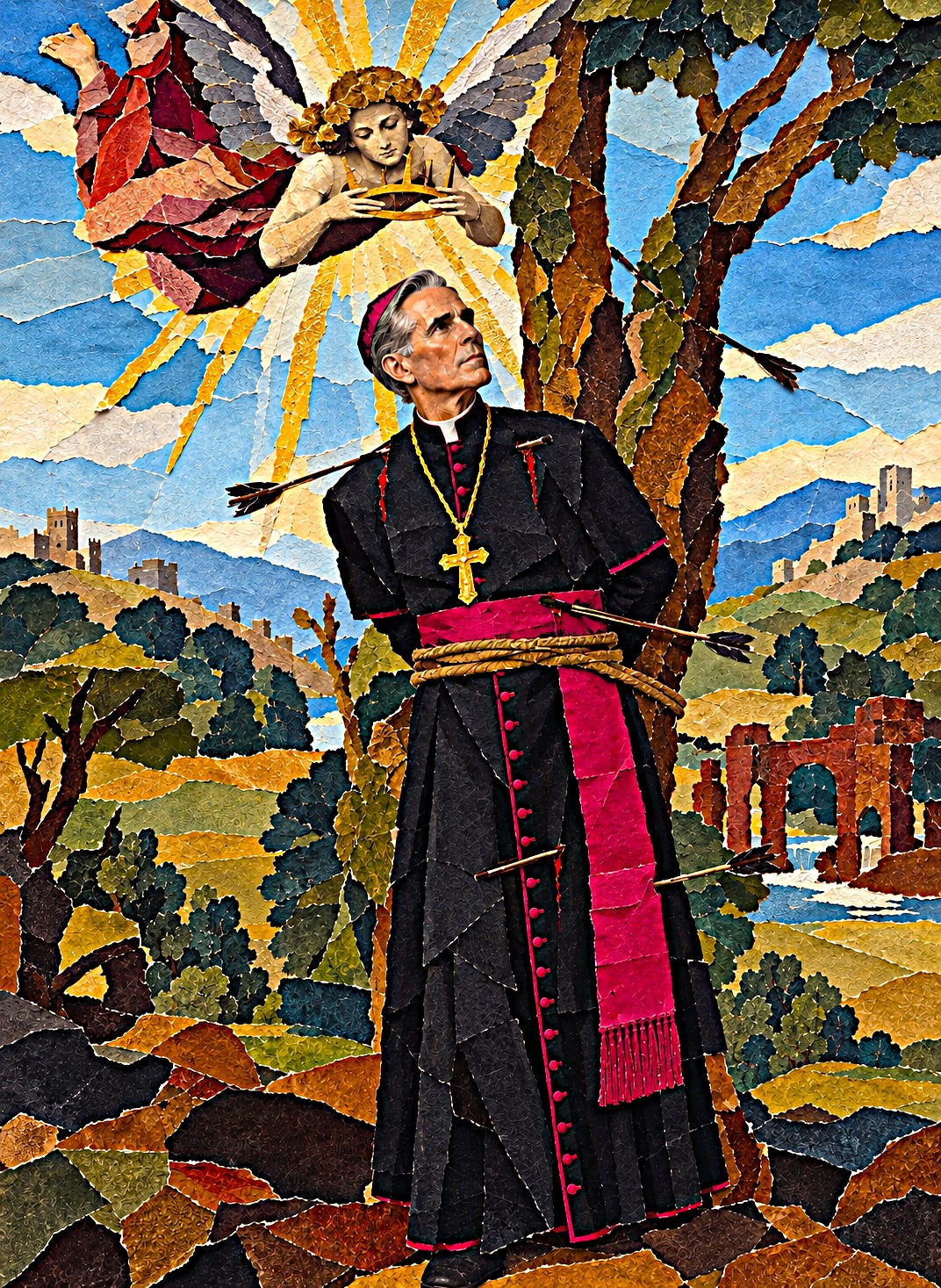
Cardinal Luis Antonio Tagle, pro-prefect of the Dicastery for Evangelization, will preside at the beatification Mass of Fulton J. Sheen at two in the afternoon on September 24, in the Dome at America’s Center in St. Louis, as the representative of Pope Leo XIV. Bishop Louis Tylka of Peoria gave three reasons for holding an Illinois bishop’s beatification in Missouri: availability, an indoor venue, and the short drive from Peoria. The hall holds seventy thousand people.
The same rite was scheduled once before, for December 21, 2019, in Peoria. Rome canceled it weeks out at the request of a few members of the United States Conference of Catholic Bishops, after Bishop Salvatore Matano of Rochester asked through the nunciature in Washington that Sheen’s role in priests’ assignments be reviewed. Msgr. James Kruse of Peoria, who had investigated the two cases at issue and found no wrongdoing, called the Rochester request a smear. Six years passed. Tylka announced on February 9, 2026 that the Holy See had cleared the way, and the Rochester diocese’s bankruptcy closed without a claim naming Sheen.
Peoria’s materials describe the evangelist. The Catholic Hour on NBC radio from 1930, Life Is Worth Living and the 1953 Emmy, sixteen years directing the Society for the Propagation of the Faith, seventy-three books. His thirty-four months as a diocesan bishop get shorter treatment, and they hold the part of his life that bears on the men who will fill that stadium.
The Church’s teaching on behalf of the poor and the vulnerable draws its most decisive opposition from inside the Church, and a bishop who acts on it should expect his cardinal, his pastors, and his donors to be the ones who resist. Sheen expected it and acted anyway. Cardinal Francis Spellman ended his television program and moved him out of New York. His own priests killed his plan to turn a parish into housing for the poor. He resigned the diocese in 1969 and called the years there a failure. Nobody outside the Church laid a hand on him. He suffered for a moral cause at the hands of Catholics who agreed with him about everything except the building.
At Vatican II, Sheen put the poor at the center of the Church.
John XXIII appointed Sheen to the Council’s Commission on the Missions, the only American on it, and he sat through all four sessions between 1962 and 1965. Joseph Ratzinger, later Benedict XVI and then a theological expert attached to the same commission, recalled decades later how Sheen held the group’s evenings with his talks. The commission produced Ad Gentes, the first treatment of the missions by an ecumenical council.
Sheen rose in St. Peter’s on November 9, 1964 to speak on the draft. He set aside the theological question of what the missions are and asked instead where they are. Mission territory, he answered, covers lands with non-Christians and also regions with few priests, few churches, and great poverty. Bishops from such places had been coming to his seat in the council hall through three sessions, from territories with “only seven to ten priests” for fifty thousand square miles. He asked whether telling them they did not belong to mission territory was worthy of the charity of Christ. Then he turned Paul’s rebuke to the Corinthians on the assembly and warned the bishops off disputing whose congregation held which map.
Asked about the session a few days later, Sheen said the note that rang out at the Council was “that the Church is to be the Church of the poor,” and that the Council had found a second presence of Christ alongside the Eucharistic presence in the tabernacle, Christ present in the poor. Ad Gentes says the same thing in its fifth article, where the Church walks the road Christ walked, “a path of poverty and obedience.” Paul VI made him bishop of Rochester twenty-three months after the speech.
In Rochester, Sheen put the teaching into practice.
He was installed in Sacred Heart Cathedral on December 15, 1966, at seventy-one, with Spellman presiding, and gave away the gifts he received that day to the missions in one sum. Within a week he had entered the biggest civil rights fight in the city, between FIGHT, the community organization led by the Rev. Franklin Florence, and Eastman Kodak. A Kodak vice president had signed an agreement with FIGHT to train and hire six hundred unemployed Black workers, and the company repudiated it within days as unauthorized. Rochester had burned in 1964. Kodak was the largest employer in the city. “Stained-glass windows are apt to becloud our vision of poverty and distress,” Sheen said during the dispute.
He was rebuilding how the diocese governed itself at the same time. He let the 583 priests of Rochester elect his vicar general, a post bishops had always filled by appointment, set up an elected council of twelve priests to advise him, and put a lay committee over diocesan finances. Time reported it in 1967 in his own phrase, “introducing democracy into administration.” He settled the future of St. Bridget’s without asking its pastor or its people.
Sheen took on the president and his own cardinal.
Lyndon Johnson called for a national day of prayer for reconciliation that summer. Sheen preached in Rochester and asked the president to announce that, for the sake of reconciliation, he would withdraw American forces from southern Vietnam immediately. He rewrote the Sermon on the Mount for the occasion: leave your prayers of reconciliation at the altar of America, be reconciled first with your brother in northern Vietnam, then come back and pray. The National Catholic Reporter printed the sermon on August 9, 1967.
Spellman, archbishop of New York, held the military vicariate for the American armed forces and had spent Christmas 1966 with the troops in Vietnam, where he made his support for the war plain. Sheen was therefore preaching against the president and against the ranking churchman of his own country, a man who had already taken his television program away from him.
At St. Bridget’s, acting on the teaching cost Sheen his own priests.
Sheen announced on Ash Wednesday that he was giving St. Bridget’s church and its buildings to the federal government as the site of low-income housing, and directed that the proceeds go to the poor. He had not consulted the pastor or the parishioners. The pastor objected at once. Pickets appeared at the chancery, and 130 priests of the diocese signed a petition protesting the abandonment of the parish’s two thousand Puerto Rican members, as the historian Jeremy Bonner records. Sheen had created the diocese’s Spanish Apostolate himself. He withdrew the offer. He resigned the diocese in October 1969, a month after the fiftieth anniversary of his ordination, and Paul VI gave him the titular see of Newport in Wales. In Treasure in Clay, the autobiography published after his death, he placed the housing offer among his failures.
The parish church burned down in 2025. The housing foundation Sheen established in Rochester outlived him. Sheen Housing repairs homes across thirteen New York counties for low-income owners, seniors, veterans, and people with disabilities.
Sheen had already learned what defying Church power could cost.
The federal government gave surplus powdered milk to the Archdiocese of New York, which passed it to Sheen’s Society for the Propagation of the Faith for distribution overseas. Spellman then billed the Society roughly a million dollars for it. Sheen refused, on the ground that the milk had cost the archdiocese nothing, and the dispute went to Pius XII, who decided for Sheen. Sheen’s niece Joan Sheen Cunningham gave the fullest account of the episode in an affidavit filed in the litigation over his remains, including her report that the pope telephoned Eisenhower to confirm that the shipments had been free.
The television program ended in 1957. Spellman canceled Sheen’s Good Friday sermon at St. Patrick’s, discouraged the New York clergy from associating with him, and, according to Sheen’s biographers, engineered his move upstate. The milk went to the missions free.
The Church that opposed Sheen now venerates him.
Leo XIV cited Ad Gentes in praising Sheen’s missionary legacy to the Pontifical Mission Societies this summer. Bishop Robert Barron’s Word on Fire published a tribute on September 1. The columnist James Pinkerton claimed him at Breitbart in February as a Cold War soldier whom fashionable historians have tried to erase. Bishop John Bonnici wore Sheen’s pectoral cross at his installation in Rochester in March, and the diocese that asked Rome to halt the cause in 2019 will now receive a first-class relic. Michael Sean Winters at the National Catholic Reporter holds to the objection that bishops of that generation should not be raised to the altars this quickly, which leaves him nearly alone among American Catholic commentators.
Spellman told the seminarians of New York that Sheen was “the most disobedient priest in the country,” according to Father Daniel Noonan, who had worked for him. Bishops and priests who wanted nothing to do with a fight avoided Sheen to stay clear of Spellman. In Rochester he filled the largest auditorium in the city for a series of retreat talks and drew almost no one, and he remarked to a priest that the whole world came to hear him except his own diocese. Thomas Reeves, his biographer, recorded the friendship with J. Edgar Hoover and the support for Joseph McCarthy that cost Sheen his standing with liberal Catholics and with most historians who came after him.
Dorothy Day warned what happens when the Church makes its troublemakers saints.
What Rome certified is a life of heroic virtue and one event. James Fulton Engstrom was born at home near Peoria on September 16, 2010 with a knot in his umbilical cord, went sixty-one minutes without a pulse while his parents prayed to Sheen, and began breathing as the team at OSF Saint Francis Medical Center prepared to call the time of death. The medical panel approved the case on March 6, 2014, the theologians that June, and Francis in July 2019. James Engstrom is fifteen now.
Tylka’s announcement invites the faithful to a deeper devotion “to the Eucharist and to Our Blessed Mother.” Tickets, a relic for veneration, the Emmy, the seventy-three books. The process asks whether Sheen practiced Christian virtue to a heroic degree across his life, and whether a healing followed from his intercession. Kodak and St. Bridget’s sit outside that examination.
“Don’t call me a saint. I don’t want to be dismissed so easily” is the line everyone knows, though Robert Ellsberg, who worked at the Catholic Worker as a young man and later edited her journals, says he put it into print in an introduction and cannot say where it came from. He does remember sitting with her over an issue of Time that listed her among living saints, and her answer that when people call you a saint, “you are not to be taken seriously.”
Truly honoring Fulton Sheen means risking episcopal comfort and acting on Catholic social teaching even when donors object, politicians threaten, priests resist, and other bishops would rather avoid the fight.
Sheen enters the calendar on September 24 as a broadcaster with a devotion to Our Lady. Cardinal Tagle will call him blessed on September 24 for the personal virtues he practiced and the healing that followed his intercession. The Church will honor Sheen and likely leave out how it fought and punished him for speaking out for social justice.
The more meaningful and harder tribute to Fulton Sheen would be for every American bishop to stand up for the poor and vulnerable even when powerful people and institutions within the Church stand in their way. That means doing more than preaching Catholic social teaching when it is safe. It means risking episcopal comfort and acting on Catholic social teaching even when donors object, politicians threaten, priests resist, and other bishops would rather stand next to the powerful or simply avoid the fight.
Thank you for reading. If you value this kind of Catholic writing, subscribe for free —and please share this essay with others who might value it.
Wow. Spellman and Sheen both held power, but what a difference in how they exercised that power!
It’s about time I got to know Archbishop Fulton Sheen as a person. He’s influenced me enough over the years.