Barron Stands Where Spellman Stood
Cardinal Francis Spellman, the Vietnam War, and the Case of Bishop Robert Barron

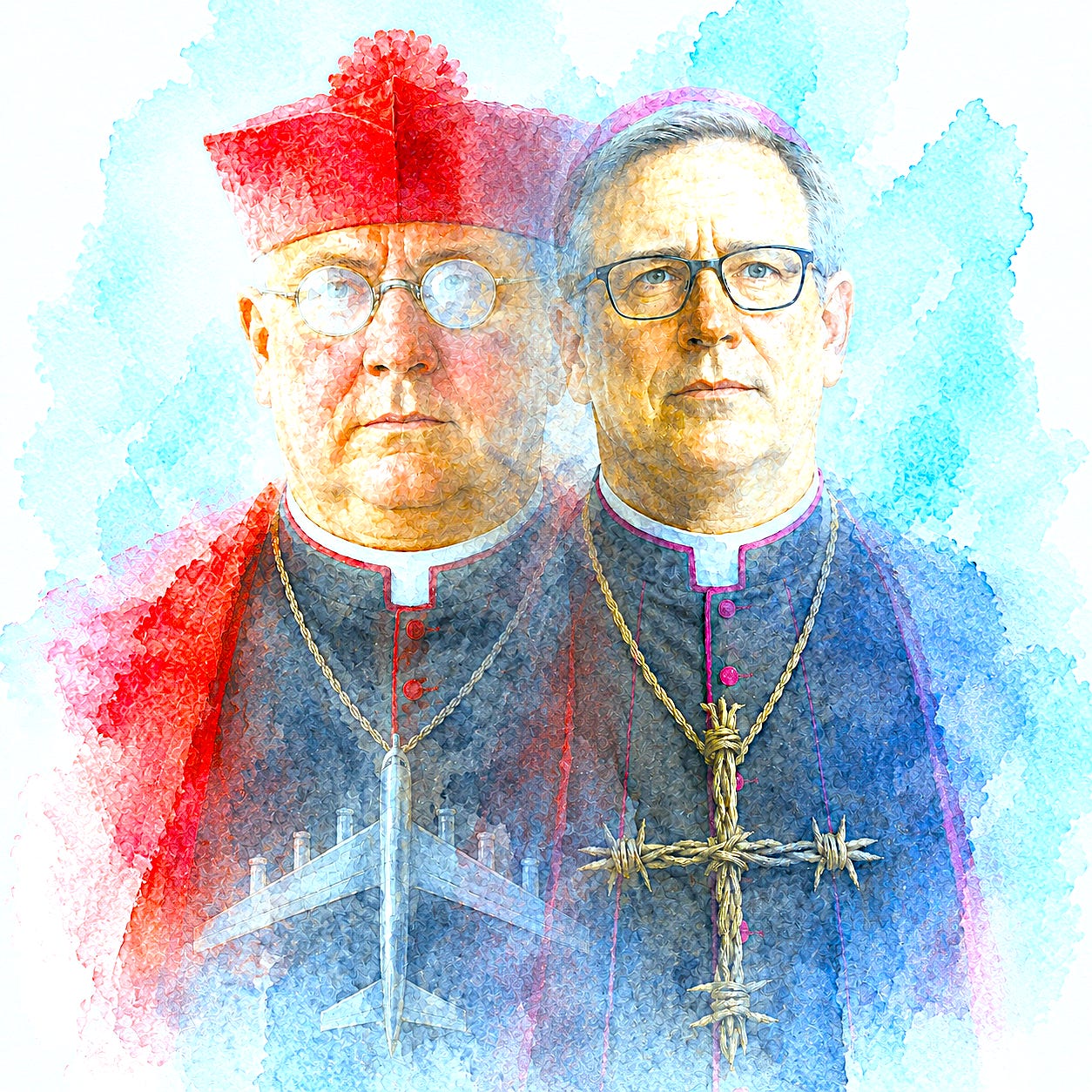
Cardinal Francis Spellman was the most powerful Catholic in the United States. He ran the Archdiocese of New York for a quarter century, served as Military Vicar of the Armed Forces, and made himself the most well-known religious supporter of the War in Vietnam. Pope Paul VI called for peace and negotiations while Spellman blessed the American escalation and the fighting. Eventually, the American bishops abandoned their most powerful member and followed the pope. As a result, Cardinal Spellman lost his influence and ended his life isolated. Bishop Robert Barron stands today where Spellman stood -- cheering on an increasingly unpopular American president engaged in an increasingly unpopular policy — now of mass deportations rather than napalm — while the pope criticizes the president’s policy as inhumane and unjust. History tells us that the Catholic Church that abandoned Cardinal Spellman in favor of the Pope will not follow Bishop Barron either.
Cardinal Spellman helped to build the alliance between American Catholicism and American power in Vietnam with his own hands. He met Ngô Đình Diệm at a Maryknoll seminary in New York in 1950, promoted him, and helped assemble the Washington lobby that sold the Diệm government to the American press under the joined banners of Catholicism and steadfast anti-Communism. He pressed Eisenhower toward intervention in 1954. As Military Vicar he blessed the American enterprise in Vietnam as it grew, and continued to support it even as many American religious leaders turned against it -- from Rev. Martin Luther King, Jr., Rev. William Sloane Coffin, Rabbi Abraham Joshua Heschel, and Rev. John C. Bennett to members of his own faith, such as Fr. John L. McKenzie, Fr. Daniel Berrigan, Fr. Philip Berrigan, and the Trappist monk Thomas Merton.
By the mid-1960s Cardinal Spellman had become one of the Vietnam War’s most prominent supporters. He traveled to Saigon in December 1966, spoke to American troops in military dress, told them to fight for total victory, and blessed the conflict as a “War for Civilization.” He described the fight as “Christ’s war against the Vietcong and the people of North Vietnam.”
In Rome, Pope Paul VI was begging the world to end that war and all wars. He had gone to the United Nations in October 1965 -- becoming the first sitting pope to visit the United States -- and pleaded that there be no more war. Just months earlier, in July 1965, President Lyndon B. Johnson had drastically increased U.S. military commitments by deploying an additional 50,000 ground troops. Pope Paul VI’s speech at the United Nations calling for “No more war; war never again,” clearly addressed the escalating American military intervention in Vietnam. He begged the international community to use the UN framework to guarantee security without resorting to weapons and arms. Later that day, more than 90,000 people packed Yankee Stadium to listen to Pope Paul VI call for peace, and an estimated 100 million Americans watched the broadcast on television.
When Cardinal Spellman pressed for total American military victory in Vietnam that December, the Vatican announced that Paul VI did not share his view. Just days after Spellman’s speech, the Vatican issued an unusual and immediate clarification to the global press as the Vatican officially announced that Cardinal Spellman did not speak for the Pope or the Holy See, and that his “total victory” comments were strictly his personal opinion.
Pope Paul VI explicitly used his subsequent public appearances to counter Spellman’s rhetoric. While Spellman was calling for military victory, the Pope addressed massive crowds in St. Peter’s Square, stating that the war could not be won on the battlefield. He repeatedly demanded an immediate cessation of the U.S. bombing campaigns over North Vietnam and urged both sides to enter into immediate, compromise-based peace talks. The Pope used the disagreement with Spellman and U.S. policy to apply Pope John XXIII’s 1963 encyclical Pacem in terris, and reminded the global Catholic community that the Church had moved away from traditional “Just War” absolute victories in the nuclear age.
Cardinal Spellman reacted to Pope Paul VI’s peace initiatives with furious but quiet insubordination, remaining entirely unmoved and aggressively doubling down on his pro-war rhetoric.
Caught between the ultra-patriotic, anti-communist, and militaristic rhetoric of Cardinal Spellman and the peace pleas of Pope Paul VI, the American Catholic hierarchy underwent one of the most profound institutional shifts in American Catholic history. In 1966, the American hierarchy reorganized into the National Conference of Catholic Bishops (NCCB) under its first president, the consensus-minded Archbishop John Dearden of Detroit. Initially, the NCCB mirrored Spellman’s staunchly anti-communist, Cold War mindset. In its November 1966 collective statement, “Peace and Vietnam,” the conference formally declared that the U.S. military presence in Vietnam was morally justified. It prioritized national loyalty and the defense of Southeast Asia over the Vatican’s diplomatic calls for an immediate halt to the violence. However, this pro-war consensus cracked rapidly as specific high-ranking prelates began breaking ranks to align directly with Pope Paul VI. Even before Spellman’s controversial Christmas 1966 call for “total victory,” Cardinal Lawrence Shehan of Baltimore issued a groundbreaking pastoral letter titled “Peace and Patriotism.” Cardinal Shehan forcefully warned that an all-out, unrestrained war violated the Christian conscience. Following Spellman’s speech, Richard Cardinal Cushing of Boston also publicly rejected the crusade-like rhetoric, demanding that the United States implement the Pope’s framework for a negotiated settlement.
This rebellion against Cardinal Spellman and the war was amplified at the grassroots level by regional groups like the newly founded Association of Chicago Priests (ACP), which collaborated with anti-war leaders to organize peace educational meetings in local parishes. This growing alliance between key archbishops and local clergy effectively isolated Cardinal Spellman, stripping him of his role as the undisputed spokesperson for American Catholicism. Cardinal Spellman died on December 2, 1967, as an iconic but increasingly isolated titan of a bygone era, and a bellicose advocate for military force who was wholly out of step with the Magisterium, the Catholic faithful, and the American people.
After Spellman’s death, the devastating aftermath of the 1968 Tet Offensive and the radical actions of the Catholic peace movement -- such as the draft board raids led by the Berrigan brothers -- pushed the institutional Church to its breaking point. The NCCB could no longer reconcile the escalating human toll with traditional Catholic “Just War” doctrines. In November 1971, under the leadership of Archbishop John Dearden, the NCCB issued its landmark “Resolution on Southeast Asia.” In a total institutional reversal, the American bishops officially declared that the war no longer met the moral criteria for a just conflict. Fully embracing Pope Paul VI’s stance, the NCCB demanded an immediate, unilateral end to U.S. involvement, solidifying a permanent shift in mainstream American Catholic leadership toward peace activism.
In the conflict between Cardinal Spellman and Pope Paul VI, the American Catholic Church chose the pope. American Catholicism first produced some of the war’s fiercest religious opponents, such as Dorothy Day and the Berrigan brothers, and the hierarchy eventually followed. In November 1971 the American bishops officially declared that the Vietnam War did not meet the conditions for a just war, reaching the judgment that Pope Paul VI had held for years.
Cardinal Spellman’s isolation and abandonment by the American Catholic Church hierarchy holds a lesson for today. The prelate who fuses the faith with American power can hold the media, the money, and the access, and the Church will still move past him to the pope, when the pope speaks the gospel of Jesus Christ.
Cardinal Spellman had faced off against lay Catholic activist Dorothy Day many times before and during the Vietnam War. In January 1949 the gravediggers who tended the cemeteries of the Archdiocese of New York went on strike. Cardinal Spellman called the walkout Communist-inspired, sent Maryknoll seminarians and his own diocesan students to break the strike by digging graves, and held out until the union accepted the archdiocese’s terms. Dorothy Day stood with the workers. She wrote to Cardinal Spellman in defense of their dignity and their right to organize and pressed him to make peace. “It is easier for the great to give in than the poor,” she told him.
The Catholic Church has since chosen between them. At the request of Cardinal John O’Connor, the Archdiocese of New York opened Dorothy Day’s cause for canonization in 2000 and gave her the title Servant of God. The American bishops endorsed the cause in 2012, Francis praised her before the United States Congress in 2015, and in 2021 the archdiocese closed its local inquiry at St. Patrick’s Cathedral and sent the cause to Rome, where it stands today. Spellman has no cause, no title, and no process. The archdiocese he ran for nearly thirty years is petitioning Rome to canonize the woman who defied him.
The verdict on holiness matches the verdict on the war. Cardinal Spellman’s power and connections won him nothing in the most significant declaration about a person’s life that the Church reserves to itself, and the woman who took the workers’ side against him, and took the side of peace when he campaigned for war, holds the honor he does not.
In our own time, Bishop Robert Barron has built the largest Catholic media platform in the United States. He attended President Trump’s address to Congress in March 2025 and likened the evening to a high liturgy of democracy, faulting only the Democrats who declined to applaud. He prayed at a National Day of Prayer in the Rose Garden and accepted a seat on the president’s Religious Liberty Commission. Like Spellman, he is close to a president who is sharply at odds with the pope. Cardinal Spellman blessed a war in Southeast Asia and the killing it required, and Bishop Barron rationalizes and defends Trump’s mass deportations and his threat to strip U.S. citizenship from the American-born children of undocumented immigrants. While Pope Leo condemned the strikes on Iran and the killings in the Caribbean, Bishop Barron told Ben Shapiro’s audience that the pope was not speaking of Iran, argued that judging a war is not the Church’s task, and kept silent on the boat strikes that Archbishop Broglio called illegal and immoral.
The story of Cardinal Spellman, the Vietnam War, and the American Catholic Church points to how the story of Bishop Barron and Donald Trump will end. The American Catholic Church rallied to Pope Paul VI and left Cardinal Spellman behind, and it will rally to Pope Leo XIV and leave Bishop Barron behind.
There is a recurring temptation for the Church, or for some of its most powerful clerics, to align itself with great wealth, state power, and military force, and history shows the Church’s eventual rejection of this temptation through the guidance of the Holy Spirit working through the papacy, the Magisterium, and Catholic social teaching.
Thank you..... Spellman told Day not to use "Catholic" in her "Catholic Worker" identification. She ignored him. Courage.
Dolan and Barron - silence on Epstein.
- silence on cuts to the poor.
- silence on cuts to USAID
- silence on healthcare cuts
-silence on hate.
Did you and Dolan preach the new testament using more than words?